Category: Azure Functions

AzureAzure Functions

Durable Task Scheduler Consumption SKU is Now Generally Available

The Durable Task Scheduler Consumption SKU has reached General Availability. If you’ve been waiting for a production-ready, pay-per-use orchestration backend for your durable workflows and AI agents on Azure — this is it. For anyone building on Azure Functions or Container Apps, this is worth paying attention to.

What is the Durable Task Scheduler?

The Durable Task Scheduler is a fully managed orchestration backend for durable execution on Azure. It handles task scheduling, state persistence, fault tolerance, and monitoring — so your workflows and agent sessions can reliably resume and run to completion through process failures, restarts, and scaling events, without you managing your own execution engine or storage backend.

It works across Azure compute environments:

  • Azure Functions — via the Durable Functions extension, across all plan types including Flex Consumption
  • Azure Container Apps — using Durable Functions or Durable Task SDKs with built-in workflow support and auto-scaling
  • Any compute — AKS, App Service, or any environment running the Durable Task SDKs (.NET, Python, Java, JavaScript)

Why the Consumption SKU Matters

Until this GA, the pay-per-use Consumption SKU was in public preview (since November 2025), while the Dedicated SKU was already the GA option for reserved capacity and higher-scale workloads. The Consumption SKU flips the model for lower-scale and variable-usage scenarios: you’re charged only for actions dispatched — with no idle costs, no minimum commitments, and no throughput to pre-size. You still pay separately for the Azure compute hosting your workflows; what the Consumption SKU removes is preprovisioned scheduler capacity and its associated idle cost.

This makes it a natural fit for workloads with spiky or unpredictable usage:

  • AI agent orchestration — multi-step agent workflows calling LLMs, retrieving data, and taking actions on demand
  • Event-driven pipelines — processing queues, webhooks, or streams with reliable checkpointing
  • API-triggered workflows — user signups, payment flows, and other request-driven processing
  • Distributed transactions — retry and compensation logic across microservices using durable sagas

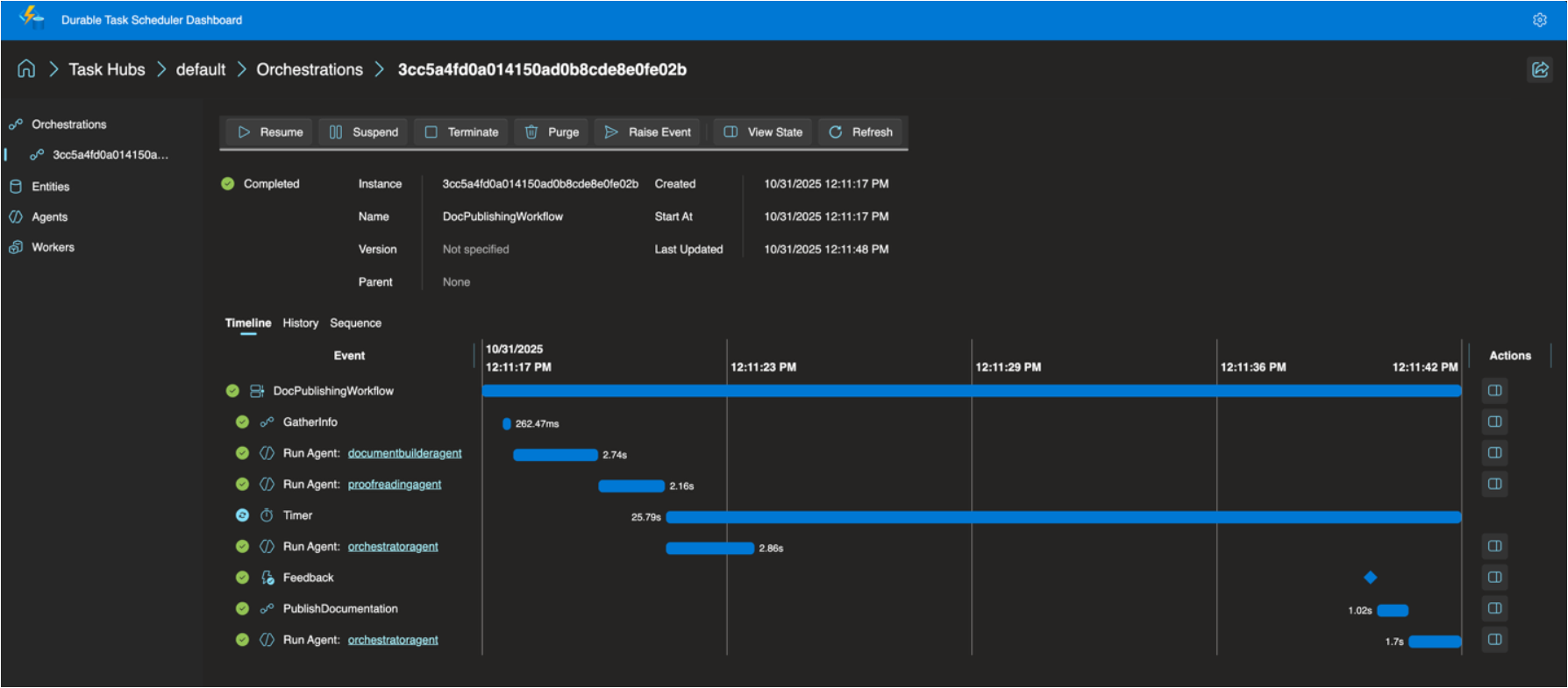
The Consumption SKU supports up to 500 actions per second and 30 days of data retention, with a built-in dashboard for filtering orchestrations, drilling into execution history, viewing visual Gantt and sequence charts, and managing instances (pause, resume, terminate, raise events) — all secured with Entra ID and RBAC. No SAS tokens or access keys. If you need more throughput or longer retention, Dedicated remains the better fit.

Read the Full Announcement

For the complete details — including billing specifics, GA hardening changes from the preview, and links to getting started — read the full announcement:

👉 The Durable Task Scheduler Consumption SKU is Now Generally Available — Azure App Service Blog

Enjoy!

References

.NETAzureAzure Functions

Upgrading Azure Functions to .NET 10 — What You Need to Know

In my Running and Building Azure Functions with Modern .NET talk last week at the Mississauga .NET User Group, the session covered a handful of topics that I think every .NET developer building on Azure Functions should know about — upgrading to .NET 10, centralizing package management, and the new solution file format. This is the first in a short series of posts walking through each of those topics. Let’s start with .NET 10 support in Azure Functions and what’s new.

.NET 10 is Now Supported in Azure Functions

Azure Functions now supports .NET 10 on runtime version 4.x, and it’s a big deal for anyone who cares about building modern, long-lived serverless applications. .NET 10 support runs until November 14, 2028, so you’ve got a solid runway once you’re on it.

A few things to keep in mind before you start your upgrade:

  • Only the isolated worker model supports .NET 10. The in-process model is not receiving a .NET 10 update and reaches end of support on November 10, 2026. If you haven’t started migrating off in-process, that date should be your motivation to get moving.
  • .NET 10 runs on Functions 4.x across most hosting plans. The one exception is Linux Consumption, which will not receive .NET 10 support. If that’s your current plan, Flex Consumption is the migration target.
  • The base container images have shifted from Debian to Ubuntu with .NET 10. If you have custom container builds, verify this against the official release notes before upgrading.

Minimum package versions required for .NET 10:

PackageMinimum Version
Microsoft.Azure.Functions.Worker2.50.0
Microsoft.Azure.Functions.Worker.Sdk2.0.5

Make sure you’re on at least these versions or the runtime will not load correctly.

Before You Upgrade — Quick Checklist

  • [ ] Confirm you’re on the isolated worker model (not in-process)
  • [ ] Confirm your hosting plan supports .NET 10 (see above)
  • [ ] Update Microsoft.Azure.Functions.Worker and Microsoft.Azure.Functions.Worker.Sdk to the minimum versions above
  • [ ] If migrating from in-process: swap Microsoft.NET.Sdk.Functions for Microsoft.Azure.Functions.Worker.Sdk, and replace Microsoft.Azure.WebJobs.* packages with Microsoft.Azure.Functions.Worker.Extensions.* equivalents
  • [ ] Verify your HTTP integration choice (see builder pattern section below)
  • [ ] Test locally with Azure Functions Core Tools v4

The New FunctionsApplication Builder Pattern

The biggest developer-facing change in .NET 10 (and technically available since .NET 8 with certain configurations) is the switch to the FunctionsApplication.CreateBuilder pattern. If you’ve been building with the older HostBuilder approach, this will feel familiar but noticeably cleaner.

Here’s what the old pattern looked like:

var host = new HostBuilder()
.ConfigureFunctionsWorkerDefaults()
.ConfigureServices(services =>
{
services.AddSingleton<IMyService, MyService>();
})
.Build();
await host.RunAsync();

And here’s the new pattern:

var builder = FunctionsApplication.CreateBuilder(args);
builder.ConfigureFunctionsWebApplication();
builder.Services.AddSingleton<IMyService, MyService>();
await builder.Build().RunAsync();

Note: ConfigureFunctionsWebApplication() is for functions apps that use ASP.NET Core HTTP integration — it wires up the ASP.NET Core middleware pipeline. If your app is non-HTTP (queue triggers, timers, Service Bus, etc.) and you don’t need that integration, use ConfigureFunctionsWorkerDefaults() instead. Most starter templates will choose the right one, but it’s worth knowing what each does.

It’s a small surface area change but the intent is meaningful. Let me walk through why this matters.

Alignment with ASP.NET Core

ASP.NET Core has used WebApplication.CreateBuilder(args) since .NET 6. Azure Functions now mirrors this with FunctionsApplication.CreateBuilder(args). This consistency across .NET workloads is genuinely helpful — developers who work on both web APIs and Azure Functions no longer need to context-switch between two different initialization mental models.

Direct Access to the Services Collection

The old pattern required you to register services inside a ConfigureServices callback, which added an extra layer of nesting. With the new pattern, you access builder.Services directly — just like you would in an ASP.NET Core Program.cs. Cleaner, more readable, and easier to reason about.

Modern .NET Host Builder Infrastructure

Under the hood, the new pattern is built on HostApplicationBuilder, the modern hosting infrastructure introduced in .NET 6+. This brings with it better performance, improved configuration ordering, and enhanced hosting abstractions. It’s part of Microsoft’s broader effort to unify .NET across web apps, Azure Functions, Worker Services, and other application types — and honestly, it’s a move in the right direction.

I have a sample application over on my GitHub: calloncampbell/FunctionAppMigration at demo3-migrated-net10

What About Flex Consumption?

If you’re migrating off Linux Consumption — or just evaluating where to run modern Azure Functions — Flex Consumption is where the platform is headed and worth understanding alongside your .NET 10 upgrade.

Flex Consumption is a Linux-based hosting plan built on a new backend internally called Legion. It keeps the serverless pay-for-what-you-use billing model you’re used to, but it adds a lot more control:

  • Scale to hundreds of instances in under a minute
  • Up to 1,000 scale-out instances (note: scale-out instances and per-instance concurrency are separate concepts — you configure concurrency independently)
  • Configurable per-instance concurrency
  • VNET integration with scale-to-zero still supported
  • Always-ready instances that reduce cold-start latency (optional; default is 0, so you pay only when you need them)
  • Multiple memory size options
  • Availability Zones support

If you’re building anything serious on Azure Functions right now, Flex Consumption paired with .NET 10 is where I’d be pointing you.

Summary

.NET 10 support in Azure Functions is a worthwhile upgrade. The migration from in-process to isolated worker model is no longer optional — with end of support coming November 2026 you need a plan. And once you’re on isolated worker with .NET 10, the new FunctionsApplication builder pattern makes initialization cleaner and more aligned with the rest of the .NET ecosystem. Pair that with a move to Flex Consumption and you’ve got a solid, modern foundation for your serverless workloads.

In the next posts in this series I’ll cover Central Package Management and the new SLNX solution file format — two more improvements that make the .NET developer experience noticeably better.

Enjoy!

References

AzureAzure Functions

What’s New with Azure Functions – Ignite 2025 Announcements

It’s that time of year for Microsoft Ignite and during this conference we usually see updates across a number of Azure services. If there’s one Azure service I always keep a close eye on, it’s Azure Functions. It sits squarely in my primary area of focus — Azure PaaS — and the Ignite 2025 announcements from the team were genuinely impressive. I won’t rehash the full product announcement here (the Azure Functions team blog post does that well), but I do want to call out the things that caught my attention and explain why they matter from where I sit.

Functions is Becoming the AI Execution Layer

Reading through the announcements, I like that Microsoft is positioning Azure Functions as a natural runtime for AI workloads — specifically MCP servers and agent-hosted tools. There are two distinct paths here worth separating:

  • GA: Author MCP tool servers using the familiar Functions triggers-and-bindings model — Functions handles the protocol mechanics and scaling.
  • Preview: Host existing official MCP SDK servers directly on Functions without rewriting them as triggers.

The GA path is the more practical entry point for most teams. It means you can build remote MCP servers using patterns you already know, and Functions handles all the protocol mechanics and scaling underneath.

There’s also built-in authentication via Entra ID and OpenID Connect for MCP servers, which addresses the main gap from the early preview. Worth noting: authorization currently secures access at the server level, not per individual tool, and fine-grained per-resource-management (PRM) authorization is still in preview. Good progress, but something to factor in before going all-in on this for production workloads.

Flex Consumption Keeps Getting Better

Azure Functions Flex Consumption is the new default hosting model and it’s the right hosting choice for most new Azure Functions workloads. The Ignite 2025 updates reinforce that view. A few highlights:

  • 512 MB instance size is now GA — right-sizing lighter workloads without paying for more memory than you need
  • Availability Zones is now GA — the last real holdout for production-critical workloads is gone
  • Rolling updates hit public preview — zero-downtime deployments by setting a single property; in-flight executions drain naturally before instances are replaced

That last one is worth keeping an eye on, but it’s still public preview and not recommended for production yet. There are also real caveats to be aware of: deployments need to be backward-compatible (especially important with Durable Functions), and single-instance apps can still see brief downtime during rollover. Still, zero-downtime deployment of Azure Functions has been a frequent customer ask and the direction is right. Outside of the Flex Consumption, we could use Deployment Slots for zero downtime deployments.

Durable Functions + AI Agents

The durable task extension for Microsoft Agent Framework is something I’ll be watching closely. The idea is straightforward: bring Durable Functions’ proven crash-resilient, distributed execution model into the Agent Framework. That means AI agents that survive restarts, maintain session context, and support human-in-the-loop patterns — all without consuming compute while waiting.

Key features of the durable task extension include:

  • Serverless Hosting: Deploy agents on Azure Functions with auto-scaling from thousands of instances to zero, while retaining full control in a serverless architecture.
  • Automatic Session Management: Agents maintain persistent sessions with full conversation context that survives process crashes, restarts, and distributed execution across instances
  • Deterministic Multi-Agent Orchestrations: Coordinate specialized durable agents with predictable, repeatable, code-driven execution patterns
  • Human-in-the-Loop with Serverless Cost Savings: Pause for human input without consuming compute resources or incurring costs
  • Built-in Observability with Durable Task Scheduler: Deep visibility into agent operations and orchestrations through the Durable Task Scheduler UI dashboard

For anyone building multi-step AI workflows where reliability and state management matter, this is worth understanding. The announcement post has more detail.

The Durable Task Scheduler Dedicated SKU also reached GA, which is good news for teams running complex, steady-state orchestrations that need predictable pricing and advanced monitoring. For context, the Durable Task Scheduler is the managed orchestration backend that powers Durable Functions execution — GA of the Dedicated SKU means production-grade support and SLAs for it. A serverless Consumption SKU for the scheduler is now in preview too.

OpenTelemetry GA

OpenTelemetry support for Azure Functions is now generally available. This one has been a long time coming. Logs, traces, and metrics through open standards — vendor-neutral, broadly supported, consistent with how the rest of your distributed system is already instrumented. Support spans .NET (isolated), Java, JavaScript, Python, PowerShell, and TypeScript. If your Functions apps are still relying on Application Insights SDK directly (I think that’s most of our apps), it’s worth looking at the OpenTelemetry migration docs. I’ll have to look at a follow-up post about this specifically.

A Few Other Things Worth Knowing

  • .NET 10 is now supported in the isolated worker model across all plans except Linux Consumption. The in-process model is not getting .NET 10 and reaches end of support November 10, 2026 — if you haven’t started that migration, now is the time.
  • Aspire 13 ships an updated preview of the Functions integration (acting as a release candidate), with GA expected in Aspire 13.1. It deploys directly to Azure Functions on Container Apps.
  • Java 25 and Node.js 24 were announced in preview at Ignite — check current docs for latest GA status.
  • Linux Consumption is retiring on September 30, 2028 — the migration guide to Flex Consumption is your starting point.

Read the Full Announcement

There’s more in the full product update — including details on security improvements, new regions, Key Vault App Config references, and the self-hosting MCP SDK preview — than I’ve covered here. I’d recommend reading through the Azure Functions Ignite 2025 Update directly if you want the complete picture.

Enjoy!

References

AzureAzure Container AppsAzure FunctionsKEDA

Moving Azure Functions from AKS to Azure Container Apps — dev.to/christle

Cover image for Moving Azure Functions from AKS to Container Apps

Take a look at this great post on moving Azure Functions from AKS over to Azure Container Apps.

Moving Azure Functions from AKS to Container Apps – DEV Community

Enjoy!

Azure FunctionsVisual Studio

Azurite emulator cannot be started

After installing Visual Studio 2022 and working with Azure Functions I noticed that a new storage emulator is being used called Azurite.

Azurite is an open source Azure Storage API compatible server (emulator). Based on Node.js, Azurite provides cross platform experiences for customers wanting to try Azure Storage easily in a local environment. Azurite simulates most of the commands supported by Azure Storage with minimal dependencies.

https://github.com/Azure/Azurite

This seemed to replace the old Azure Storage Emulator you would run previously when doing local development. I quickly came across an issue where the Azurite emulator cannot be started because port 10000 is already in use. This is also applied to ports 10001 and 10002 which it uses. Here are the contents of the Service Dependencies from the Visual Studio 2022 Output pane:

Ensuring Azure Functions Core Tools are up to date. This may take a few minutes...
Azure Functions Core Tools are up to date.
DotNetCore31-FunctionApp: Azurite emulator cannot be started because port 10000 is already in use. Another instance of the Azurite emulator or Azure Storage emulator might be already running on your machine.
DotNetCore31-FunctionApp: We detected that Azure Storage emulator is running on your machine. The Azure Storage emulator is now deprecated. Microsoft recommends that you use the Azurite emulator for local development with Azure Storage. Follow the directions in the link 'https://go.microsoft.com/fwlink/?LinkID=2167087' to install and run Azurite emulator.
Unable to start dependency 'functions.storage1'.
Ensuring Azure Functions Core Tools are up to date. This may take a few minutes...
Azure Functions Core Tools are up to date.
Ensuring Azure Functions Core Tools are up to date. This may take a few minutes...
Azure Functions Core Tools are up to date.
DotNetCore31-FunctionApp: Azurite emulator cannot be started because port 10000 is already in use. Another instance of the Azurite emulator or Azure Storage emulator might be already running on your machine.
DotNetCore31-FunctionApp: We detected that Azure Storage emulator is running on your machine. The Azure Storage emulator is now deprecated. Microsoft recommends that you use the Azurite emulator for local development with Azure Storage. Follow the directions in the link 'https://go.microsoft.com/fwlink/?LinkID=2167087' to install and run Azurite emulator.
Unable to start dependency 'storage1'.
DotNetCore31-FunctionApp: Azurite emulator cannot be started because port 10000 is already in use. Another instance of the Azurite emulator or Azure Storage emulator might be already running on your machine.
DotNetCore31-FunctionApp: We detected that Azure Storage emulator is running on your machine. The Azure Storage emulator is now deprecated. Microsoft recommends that you use the Azurite emulator for local development with Azure Storage. Follow the directions in the link 'https://go.microsoft.com/fwlink/?LinkID=2167087' to install and run Azurite emulator.
Unable to start dependency 'storage1'.

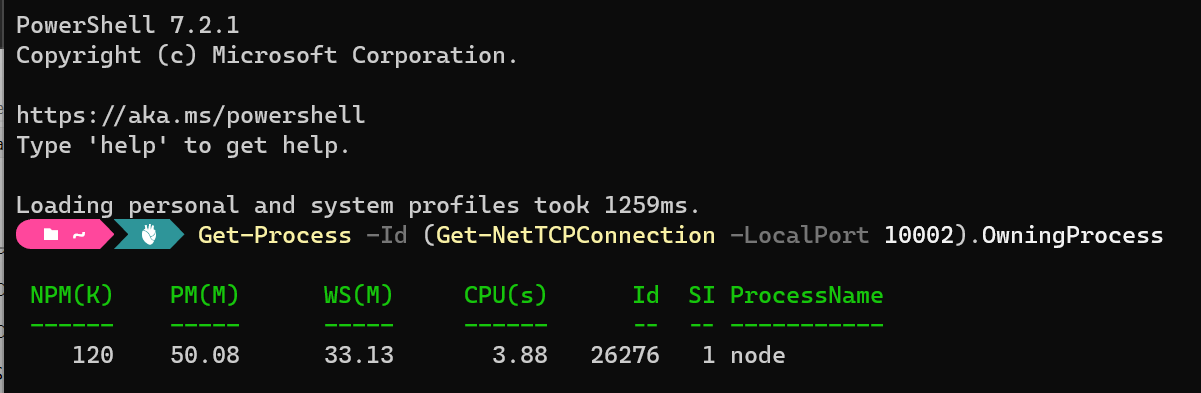
Let’s drop into Windows Terminal and take a look at what process is using that port:

Get-Process -Id (Get-NetTCPConnection -LocalPort 10002).OwningProcess

After stopping the Node process and re-running Azurite (I restarted Visual Studio) we can see everything starts up as expected:

Ensuring Azure Functions Core Tools are up to date. This may take a few minutes...
Azure Functions Core Tools are up to date.
DotNetCore31-FunctionApp: azurite.cmd --location "C:\Users\ccampbell\AppData\Local\Temp\Azurite" --debug "C:\Users\ccampbell\AppData\Local\Temp\Azurite\debug.log"
DotNetCore31-FunctionApp: Azurite Blob service is starting at http://127.0.0.1:10000
DotNetCore31-FunctionApp: Azurite Blob service is successfully listening at http://127.0.0.1:10000
DotNetCore31-FunctionApp: Azurite Queue service is starting at http://127.0.0.1:10001
DotNetCore31-FunctionApp: Azurite Queue service is successfully listening at http://127.0.0.1:10001
DotNetCore31-FunctionApp: Azurite Table service is starting at http://127.0.0.1:10002
DotNetCore31-FunctionApp: Azurite Table service is successfully listening at http://127.0.0.1:10002

This was not a great experience on the first day I started to use Visual Studio 2022 with Azure Functions as I had to go off and figure out why the Azure emulator could not be started instead of just working on my application. You can go and change the default ports ft you like which is mentioned in the documentation. For more information on Azurite check out the docs on their GitHub repository.

I hope this helps with anyone new to the Azurite emulator in Visual Studio 2022.

Enjoy!

References

https://docs.microsoft.com/en-us/azure/storage/common/storage-use-azurite?tabs=visual-studio

https://github.com/Azure/Azurite