Category: Uncategorized

Uncategorized

Fixing Azure Portal Errors

Chris Pietschmann's avatarBuild5Nines

All software has errors. The Microsoft Azure Portal is no different. When this happens you’ll receive one of two different alerts of the error; either an error message or a rain cloud. It’s easy to have a “table flip” moment when this occurs and start grumbling how “the cloud is horrible” or “why Azure sucks”, but there’s generally an explanation for these errors and they normally don’t last long. This post explains a bit of why these errors occur, when they’re more likely, and how to fix / workaround them.

View original post 827 more words

Uncategorized

How big is the Microsoft Azure Cloud?

Chris Pietschmann's avatarBuild5Nines

The Microsoft Azure Cloud is huge. Or should I say H-y-uuuuu-ge! It’s the largest cloud provider in the world with 38 Regions currently (30 online) spread across the globe, and Microsoft keeps adding more regions every few months. Microsoft has been betting the future of their Enterprise business on Azure since the initial General Availability in 2010, and they’ve increased their efforts over the last couple of years as the “Cloud Wars” have been speeding up.

Microsoft has been a little vague over the years. They publish how many Azure Regions there are, and what cities they’re located in. I’ve put together a map that plots the city location of each of the Azure Regions to help visualize things on the Region side of the equation. However, they don’t disclose the street addresses of the data centers, and until recently they haven’t exactly stated how many data centers make up the 38…

View original post 271 more words

Uncategorized

CloudDays™ – Quick Start to Azure Redis Cache

Bruce D Kyle's avatarDevDays®

redisAzure Redis Cache helps your application become more responsive even as user load increases and leverages the low latency, high-throughput capabilities of the Redis engine. This separate distributed cache layer allows your data tier to scale independently for more efficient use of compute resources in your application layer.

Redis is an open source, BSD licensed, advanced key-value cache and store. It is often referred to as a data structure server since keys can contain strings, hashes, lists, sets, sorted sets, bitmaps and hyperloglogs. Redis supports a set of atomic operations on these data types.

Microsoft Azure Redis Cache is based on this cache and store. It gives you access to a secure, dedicated Redis cache, managed by Microsoft, providing the best of both worlds: the rich features and ecosystem of Redis, and reliable hosting and monitoring by Microsoft.

You can use Redis from

View original post 1,771 more words

Uncategorized

CloudDays™ – Choosing the Right Azure Cache Technology

Bruce D Kyle's avatarDevDays®

azurecloudMicrosoft Azure Cache is a family of distributed, in-memory, scalable solutions that enable you to build highly scalable and responsive applications by providing super-fast access to your data. But what do you choose?

This post provides you with an overview of the options you have when you are considering caching technologies.

Microsoft Azure Cache is available in the following offerings.

Microsoft offers a strong recommended choice for these caches. “Microsoft recommends all new developments use Azure Redis Cache.”

That said, this post discusses each to give you a quick overview. This article also introduces you to one other cache.

Here’s the short answer:

  • Use Azure Redis Cache when you want to cache string, hashes, .NET classes, data.
  • Use CDN when you want to cache audio, video, applications, images, and other files.

View original post 592 more words

Uncategorized

Happy 7th Birthday Microsoft Azure!

Chris Pietschmann's avatarBuild5Nines

February 1, 2017 marks the 7th anniversary of when Microsoft turned on billing for the new Microsoft Azure service. Happy birthday Azure! Initially the service had a fraction of the features and services it has today. There’s been a tremendous growth on the platform over the years as a result of incredible investment by Microsoft.

Here’s a little timeline information about Microsoft Azure that you may or may not know:

  • October 2008  – At the Microsoft Professional Developers Conference (PDC), Microsoft Chief Software Architect Ray Ozzie announces a new cloud computing platform from Microsoft called Windows Azure. The initial announcement includes the Azure services of: Cloud Services, and Blob Storage.
  • March 2009 – Azure SQL Database service was announced.
  • November 2009 – An updated Windows Azure CTP is released enabling Full Trust, PHP, Java, including a CDN CTP and more
  • January 2010 – Windows Azure become Generally Available, currently free…

View original post 380 more words

Uncategorized

Searchable Azure Book Catalog from Build Azure

Great resource for finding Azure related material.

Unknown's avatarBuild5Nines

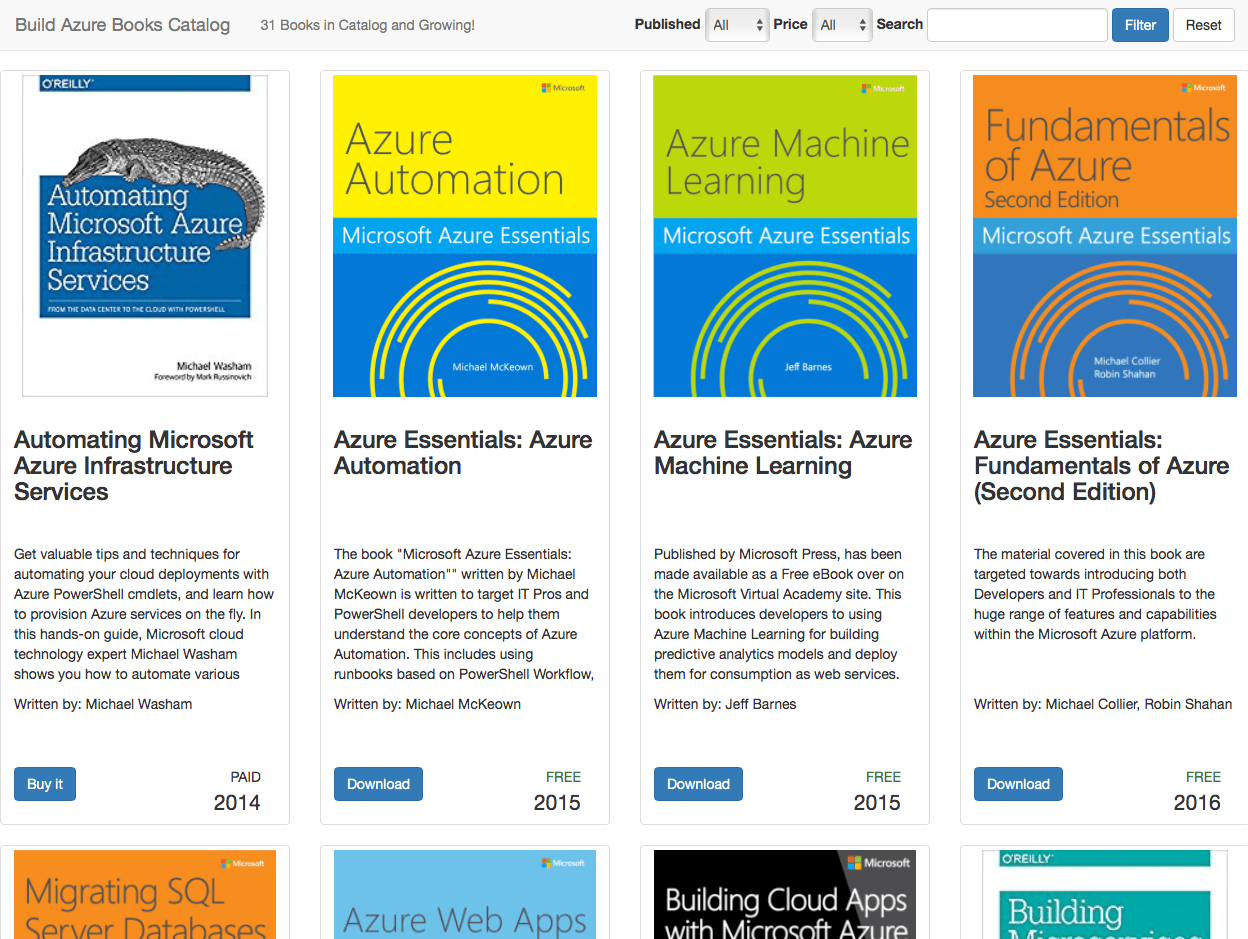
It’s generally difficult to find a good book on cloud and Microsoft Azure related material to help learn from. This can be extremely frustrating when you’re new to a technology and are looking for a concise source to get up to speed, and good books are the perfect solution to this. After some deliberation, I’ve decided to start a new project for Build Azure. The new project is the Build Azure Book Catalog, and it’s located at http://books.buildazure.com

buildazurebookcatalogscreenshot001

View original post 335 more words

Uncategorized

Azure Web Apps only in Current Portal from February 1, 2017

Unknown's avatarBuild5Nines

azure-app-service-web-app_colorMicrosoft has been working for a couple years to add support to all existing Azure services, as well as a plethora of new services, within the Current Azure Portal (http://portal.azure.com). One of the huge services that wasn’t available in the Current Azure Portal until recently is Azure AD; which is still in Preview within the Current Portal. However, Azure Web Apps have been supported in the Current Azure Portal for about 2 years or so at this point, and Microsoft is taking this new / current portal migration even further…

Starting February 1, 2017, Azure Web Apps will no longer be available in the “Classic” Azure Portal (http://manage.windowsazure.com). For most the duality of the Portals has been a bit frustrating, and it’s relieving to see that Microsoft is making the move to not just add support for services in the Current Portal, but also remove them…

View original post 80 more words

Uncategorized

Observable’s in Angular 2 (RxJS)

Aamol Gote's avatarmytechnetknowhows

Observables in Angular 2 can be achieved using RxJS(Reactive Extensions for JavaScript). Observables is an ES7 feature so you need to make use of an external library to use it today. RxJS is a library that allows you to work with asynchronous data streams. So what are asynchronous data streams?

  • Asynchronous – we can call a function and register a callback to be notified when results are available, so we can continue with execution and avoid the Web Page from being unresponsive. This is used for ajax calls, DOM-events, Promises, WebWorkers and WebSockets.
  • Data – raw information in the form of JavaScript data types as: Number, String, Objects (Arrays, Sets, Maps).
  • Streams – sequences of data made available over time. Technically everything is stream.

Observables can help manage async data and a few other useful patterns. Observables are similar to Promises but with a few key differences. The first is Observables emit multiple…

View original post 853 more words

Uncategorized

Microsoft Azure Architecture Blueprints & Free Visio Symbols

Unknown's avatarBuild5Nines

AzureBlueprintThumb2

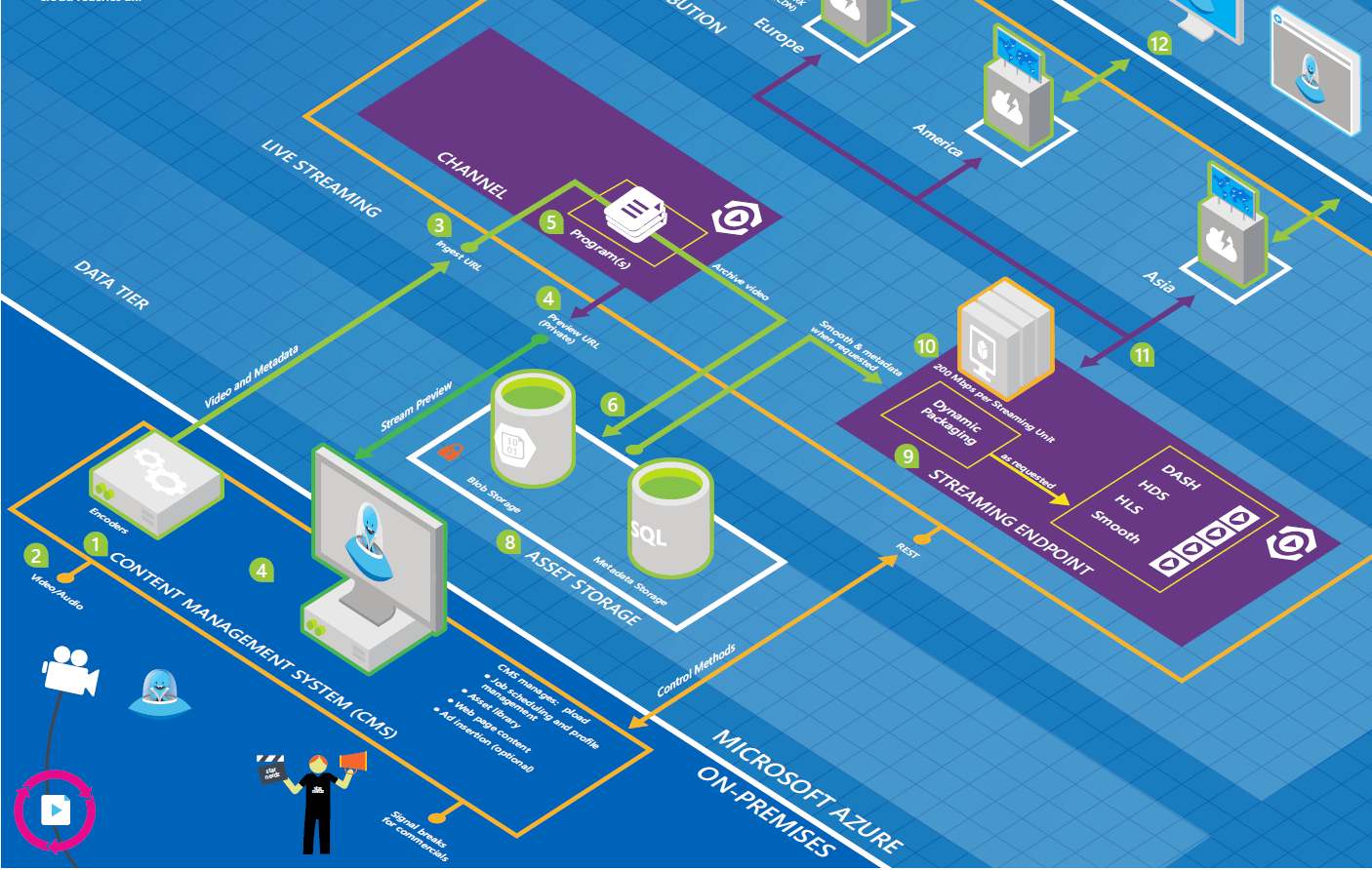
Microsoft distributes some really nice looking Azure architecture diagrams / blueprints (like the one on the right) in various materials and even includes them in keynotes, presentations and other places. These really seem like they must be created with Photoshop by a graphic designer. However, this is not the case.

These architecture diagrams are created using Visio! If you have Visio, you too can get your hands on the various assets necessary to create your own awesome architecture diagrams like these!

View original post 145 more words

Uncategorized

Microsoft Certified for IoT Device Catalog

Chris Pietschmann's avatarBuild5Nines

There are a number of Microsoft Certified for IoT Starter Kits available. These are tailors mostly to prototyping solutions, as they come with a number of sensors and things necessary to get started building. However, if you know what platforms you want to target, or are looking for a number of platforms to choose from, then you’ll want to look through the catalog of Microsoft Certified for IoT devices.

Rather than just having a documentation page or PDF that lists out what all the Certified for IoT Devices are, Microsoft has created a catalog website that’s easily searchable and filterable. Using the official Azure Certified for IoT device catalog can really help you find the perfect IoT hardware for your next IoT project; especially industrial or commercial projects.

The Azure Certified for IoT device catalog is located at: https://catalog.azureiotsuite.com

msazurecertifiediotdevicecatalog

View original post