José Simões’ new book, Embedded Systems with nanoFramework, is a milestone for anyone who’s ever wanted to bring the power and comfort of C# into the world of microcontrollers. What I love about this work is how it breaks down the traditional barriers of embedded development—complex toolchains, steep learning curves, and hardware‑specific code—and replaces them with a modern, flexible, developer‑friendly approach.
At its core, the book shows how the .NET nanoFramework lets you build IoT and embedded solutions quickly, cleanly, and affordably. You can prototype in hours, adapt to customer needs on the fly, and move across ESP32.
José brings deep experience as the founder of the nanoFramework and a multi‑year Microsoft MVP, and it shows.
For a deeper dive on the book, checkout Sander’s post where he goes more in depth.
What is the Book of News? The Microsoft Build 2024 Book of News is your guide to the key news items announced at Build 2024.
As expected there is a lot of focus on Azure and AI, followed by Microsoft 365, Security, Windows, and Edge & Bing. This year the book of news is interactive instead of being a PDF.
Some of my favourite announcements
Azure Cloud Native and Application Platform
Azure Functions
Microsoft Azure Functions is launching several new features to provide more flexibility and extensibility to customers in this era of AI.
Features now in preview include:
A Flex Consumption plan that will give customers more flexibility and customization without compromising on available features to run serverless apps.
Extension for MicrosoftAzure OpenAIService that will enable customers to easily infuse AI in their apps. Customers will be able to use this extension to build new AI-led apps like retrieval-augmented generation, text completion and chat assistant.
Visual Studio Code for the Web will provide a browser-based developer experience to make it easier to get started with Azure Functions. This feature is available for Python, Node and PowerShell apps in the Flex Consumption hosting plan.
Features now generally available include:
Azure Functions on Azure Container Apps lets developers use the Azure Container Apps environment to deploy multitype services to a cloud-native solution designed for centralized management and serverless scale.
Dapr extension for Azure Functions enables developers to use Dapr’s powerful cloud native building block APIs and a large array of ecosystem components in the native and friendly Azure Functions triggers and bindings programming model. The extension is available to run on Azure Kubernetes Service and Azure Container Apps.
Azure Container Apps
Microsoft Azure Container Apps will include dynamic sessions, in preview, for AI app developers to instantly run large language model (LLM)-generated code or extend/customize software as a service (SaaS) apps in an on-demand, secure sandbox.
Customers will be able to mitigate risks to their security posture, leverage serverless scale for their apps and save months of development work, ongoing configurations and management of compute resources that reduce their cost overhead. Dynamic sessions will provide a fast, sandboxed, ephemeral compute suitable for running untrusted code at scale.
Additional new features, now in preview, include:
Support for Java: Java developers will be able to monitor the performance and health of apps with Java metrics such as garbage collection and memory usage.
Microsoft .NET Aspire dashboard: With dashboard support for .NET Aspire in Azure Container Apps, developers will be able to access live data about projects and containers in the cloud to evaluate the performance of .NET cloud-native apps and debug errors.
Azure App Service
Microsoft Azure App Service is a cloud platform to quickly build, deploy and run web apps, APIs and other components. These capabilities are now in preview:
Sidecar patterns is a way to add extra features to the main app, such as logging, monitoring and caching, without changing the app code. Users will be able to run these features alongside the app and it is supported for both source code and container-based deployments.
WebJobs will be integrated with Azure App Service, which means they will share the same compute resources as the web app to help save costs and ensure consistent performance. WebJobs are background tasks that run on the same server as the web app and can perform various functions, such as sending emails, executing bash scripts and running scheduled jobs.
GitHub Copilot skills for Azure Migrate will enable users to ask questions like, “Can I migrate this app to Azure?” or “What changes do I need to make to this code?” to get answers and recommendations from Azure Migrate. GitHub Copilot licenses are sold separately.
These capabilities are now generally available:
Automatic scaling continuously adjusts the number of servers that run apps based on a combination of demand and server utilization, without any code or complex scaling configurations. This helps users handle dynamically changing site traffic without over-provisioning or under-provisioning the app’s server resources.
Availability zones are isolated locations within an Azure region that provide high availability and fault tolerance. Enabling availability zones lets users take advantage of the increased service level agreement (SLA) of 99.99%. For more information, reference the SLA for App Service.
TLS 1.3 encryption, the latest version of the protocol that secures communication between apps and the clients, offers faster and more secure connections, as well as better compatibility with modern browsers and devices.
Azure Static Web Apps
To help customers deliver more advanced capabilities, Microsoft Azure Static Web Apps will offer a dedicated pricing plan, now in preview, that supports enterprise-grade features for enhanced networking and data storage. The dedicated plan for Azure Static Web Apps will utilize dedicated compute capacity and will enable:
Network isolation to enhance security.
Data residency to help customers comply with data management policies and requirements.
Enhanced quotas to allow for more custom domains within an app service plan.
“Always-on” functionality for Azure Static Web Apps managed functions, which provide built-in API endpoints to connect to backend services.
Azure Logic Apps
Microsoft Azure Logic Apps is a cloud platform where users can create and run automated workflows with little to no code. Updates to the platform include:
An enhanced developer experience:
Improved onboarding experience in Microsoft Visual Studio Code: A simplified extension installation experience and improvements on project start and debugging are now generally available.
Logic Apps Standard deployment scripting toolsin Visual Studio Code: This feature will simplify the process of setting up a continuous integration/continuous delivery (CI/CD) process for Logic Apps Standard by providing support in the tooling to generalize common metadata files and automate the creation of infrastructure scripts to streamline the task of preparing code for automated deployments. This feature is in preview.
Support for Zero Downtime deployment scenarios: This will enable Zero Downtime deployment scenarios for Logic Apps Standard by providing support for deployment slots in the portal. This update is in preview.
Expanded functionality and compatibility with Logic Apps Standard:
.NET Custom Code Support: Users will be able to extend low-code workflows with the power of .NET 8 by authoring a custom function and calling from a built-in action within the workflow. This feature is in preview.
Logic Apps connectors for IBM mainframe and midranges: These connectors allow customers to preserve the value of their workloads running on mainframes and midranges by allowing them to extend to the Azure Cloud without investing more resources in the mainframe or midrange environments using Azure Logic Apps. This update is generally available.
Other updates, in preview, include Azure Integration account enhancements and Logic Apps monitoring dashboard.
Azure API Center
Microsoft Azure API Center, now generally available, provides a centralized solution to manage the challenges of API sprawl, which is exacerbated by the rapid proliferation of APIs and AI solutions. The Azure API Center offers a unified inventory for seamless discovery, consumption and governance of APIs, regardless of their type, lifecycle stage or deployment location. This enables organizations to maintain a complete and current API inventory, streamline governance and accelerate consumption by simplifying discovery.
Azure API Management
Azure API Management has introduced new capabilities to enhance the scalability and security of generative AI deployments. These include the Microsoft Azure OpenAI Service token limit policy for fair usage and optimized resource allocation, one-click import of Azure OpenAI Service endpoints as APIs, a Load Balancer for efficient traffic distribution and a Circuit breaker to protect backend services.
Other updates, now generally available, include first-class support for OData API type, allowing easier publication and security of OData APIs, and full support for gRPC API type in self-hosted gateways, facilitating the management of gRPC services as APIs.
Azure Event Grid
Microsoft Azure Event Grid has new features that are tailored to customers who are looking for a pub-sub message broker that can enable Internet of Things (IoT) solutions using MQTT protocol and can help build event-driven apps. These capabilities enhance Event Grid’s MQTT broker capability, make it easier to transition to Event Grid namespaces for push and pull delivery of messages, and integrate new sources. Features now generally available include:
Use the Last Will Testament feature, in compliance with MQTT v5 and MQTT v.3.1.1 specifications, so apps receive notifications when clients get disconnected, enabling management of downstream tasks to prevent performance degradation.
Create data pipelines that utilize both Event Grid Basic resources and Event Grid Namespace Topics (supported in Event Grid Standard). This means customers can utilize Event Grid namespace capabilities, such as MQTT broker, without needing to reconstruct existing workflows.
Support new event sources, such as Microsoft Entra ID and Microsoft Outlook, leveraging Event Grid’s support for the Microsoft Graph API. This means customers can use Event Grid for new use cases, like when a new employee is hired or a new email is received, to process that information and send to other apps for more action.
Azure Data Platform
Real-Time Intelligence in Microsoft Fabric
The new Real-Time Intelligence within Microsoft Fabric will provide an end-to-end software as a service (SaaS) solution that will empower customers to act on high volume, time-sensitive and highly granular data in a proactive and timely fashion to make faster and more-informed business decisions. Real-Time Intelligence, now in preview, will empower user roles such as everyday analysts with simple low-code/no-code experiences, as well as pro developers with code-rich user interfaces.
Features of Real-Time Intelligence will include:
Real-Time hub, a single place to ingest, process and route events in Fabric as a central point for managing events from diverse sources across the organization. All events that flow through Real-Time hub will be easily transformed and routed to any Fabric data stores.
Event streams that will provide out-of-the-box streaming connectors to cross cloud sources and content-based routing that helps remove the complexity of ingesting streaming data from external sources.
Event house and real-time dashboards with improved data exploration to assist business users looking to gain insights from terabytes of streaming data without writing code.
Data Activator that will integrate with the Real-Time hub, event streams, real-time dashboards and KQL query sets, to make it seamless to trigger on any patterns or changes in real-time data.
AI-powered insights, now with an integrated Microsoft Copilot in Fabric experience for generating queries, in preview, and a one-click anomaly detection experience, allowing users to detect unknown conditions beyond human scale with high granularity in high-volume data, in private preview.
Event-Driven Fabric will allow users to respond to system events that happen within Fabric and trigger Fabric actions, such as running data pipelines.
New capabilities and updates to Microsoft Fabric
Microsoft Fabric, the unified data platform for analytics in the era of AI, is a powerful solution designed to elevate apps, whether a user is a developer, part of an organization or an independent software vendor (ISV). Updates to Fabric include:
Fabric Workload Development Kit: When building an app, it must be flexible, customizable and efficient. Fabric Workload Development Kit will make this possible by enabling ISVs and developers to extend apps within Fabric, creating a unified user experience.This feature is now in preview.
Fabric Data Sharingfeature: Enables real-time data sharing across users and apps. The shortcut feature API allows seamless access to data stored in external sources to perform analytics without the traditional heavy integration tax. The new Automation feature now streamlines repetitive tasks resulting in less manual work, fewer errors and more time to focus on the growth of the business. These features are now in preview.
GraphQL APIanduser data functions in Fabric: GraphQL API in Fabric is a savvy personal assistant for data. It’s a RESTful API that will let developers access data from multiple sources within Fabric, using a single query. User data functions will enhance data processing efficiency, enabling data-centric experiences and apps using Fabric data sources like lakehouses, data warehouses and mirrored databases using native code ability, custom logic and seamless integration.These features are now in preview.
AI skills in Fabric: AI skills in Fabric is designed to weave generative AI into data specific work happening in Fabric. With this feature, analysts, creators, developers and even those with minimal technical expertise will be empowered to build intuitive AI experiences with data to unlock insights. Users will be able to ask questions and receive insights as if they were asking an expert colleague while honoring user security permissions.This feature is now in preview.
Copilot in Fabric: Microsoft is infusing Fabric with Microsoft Azure OpenAI Service at every layer to help customers unlock the full potential of their data to find insights. Customers can use conversational language to create dataflows and data pipelines, generate code and entire functions, build machine learning models or visualize results. Copilot in Fabric is generally available in Power BI and available in preview in the other Fabric workloads.
Azure Cosmos DB
Microsoft Azure Cosmos DB, the database designed for AI that allows creators to build responsive and intelligent apps with real-time data ingested and processed at any scale, has several key updates and new features that include:
Built-in vector database capabilities: Azure Cosmos DB for NoSQL will feature built-in vector indexing and vector similarity search, enabling data and vectors to be stored together and to stay in sync. This will eliminate the need to use and maintain a separate vector database. Powered by DiskANN, available in June, Azure Cosmos DB for NoSQL will provide highly performant and highly accurate vector search at any scale. This feature is now in preview.
Serverless to provisioned account migration: Users will be able to transition their serverless Azure Cosmos DB accounts to provisioned capacity mode. With this new feature, transition can be accomplished seamlessly through the Azure portal or Azure command-line interface (CLI). During this migration process, the account will undergo changes in-place and users will retain full access to Azure Cosmos DB containers for data read and write operations.This feature is now in preview.
Cross-region disaster recovery: With disaster recovery in vCore-based Azure Cosmos DB for MongoDB a cluster replica can be created in another region. This cluster replica will be continuously updated with the data written in the primary region. In a rare case of outage in the primary region and primary cluster unavailability, this replica can be promoted to become the new read-write cluster in another region. Connection string is preserved after such a promotion, so that apps can continue to read and write to the database in another region using the same connection string. This feature is now in preview.
Azure Cosmos DB Vercel integration: Developers building apps using Vercel can now connect easily to an existing Azure Cosmos DB database or create new Azure Try Cosmos DB accounts on the fly and integrate them to their Vercel projects. This integration improves productivity by creating apps easily with a backend database already configured. This also helps developers onboard to Azure Cosmos DB faster. This feature is now generally available.
Go SDK for Azure Cosmos DB: The Go SDK allows customers to connect to an Azure Cosmos DB for NoSQL account and perform operations on databases, containers and items. This release brings critical Azure Cosmos DB features for multi-region support and high availability to Go, such as the ability to set preferred regions, cross-region retries and improved request diagnostics. This feature is now generally available.
In previous articles, we have covered various basic aspects of Blazor WebAssembly application. In this article, we are going to demonstrate how the Blazor WebAssembly app can be deployed in an Azure App Service. What are various options for deploying Blazor Apps ? There are two different types of Blazor applications – Blazor Server Apps…
MAUI finally had its day in the limelight at .NETConf with a dedicated “focused” event. There was a lot of good content shared in a roughly 8 hours long live stream. In addition to live stream, there are recorded sessions that are also available at .NET YouTube channel. Here are some of the highlights from the event that I am excited about.
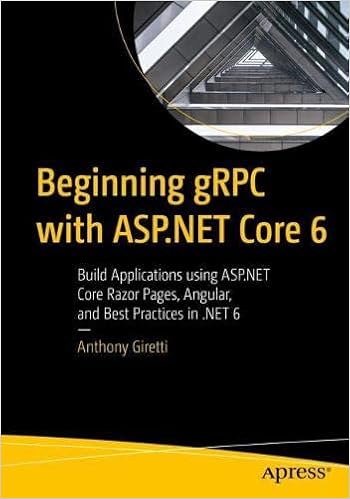
My good friend Anthony Giretti, a Microsoft MVP in Developer Technologies has recently published his book “Beginning gRPC with ASP.NET Core 6″ and I wanted to share the news with the community.
About the book
Beginning gRPC with ASP.NET Core 6 is your guide to quickly and efficiently getting down to the business of building gRPC applications in the Microsoft .NET ecosystem. Readers will dive in and build an application using gRPC and the latest technologies such Angular and ASP.NET Core Razor Pages.
This book will teach you how to set up an efficient application using industry best practices such as security, monitoring, logging, testing, and more. You will do this by performing Create, Read, Update, and Delete (CRUD) operations on a SQL Server database with Entity Framework Core. From there you will build web applications using Angular and ASP.NET Core Razor pages combined with gRPC APIs.After reading the book, you’ll be able to take advantage of the full range of developer opportunities with gRPC, and come away with any understanding of which usage scenarios are best suited for your projects. And you will possess a solid understanding of the best way to build APIs with ASP.NET Core.
What You Will Learn
Benefit from a new way to design APIs
Build modern web applications
Migrate easily from WCF to gRPC
Become comfortable with latest industry programming standards
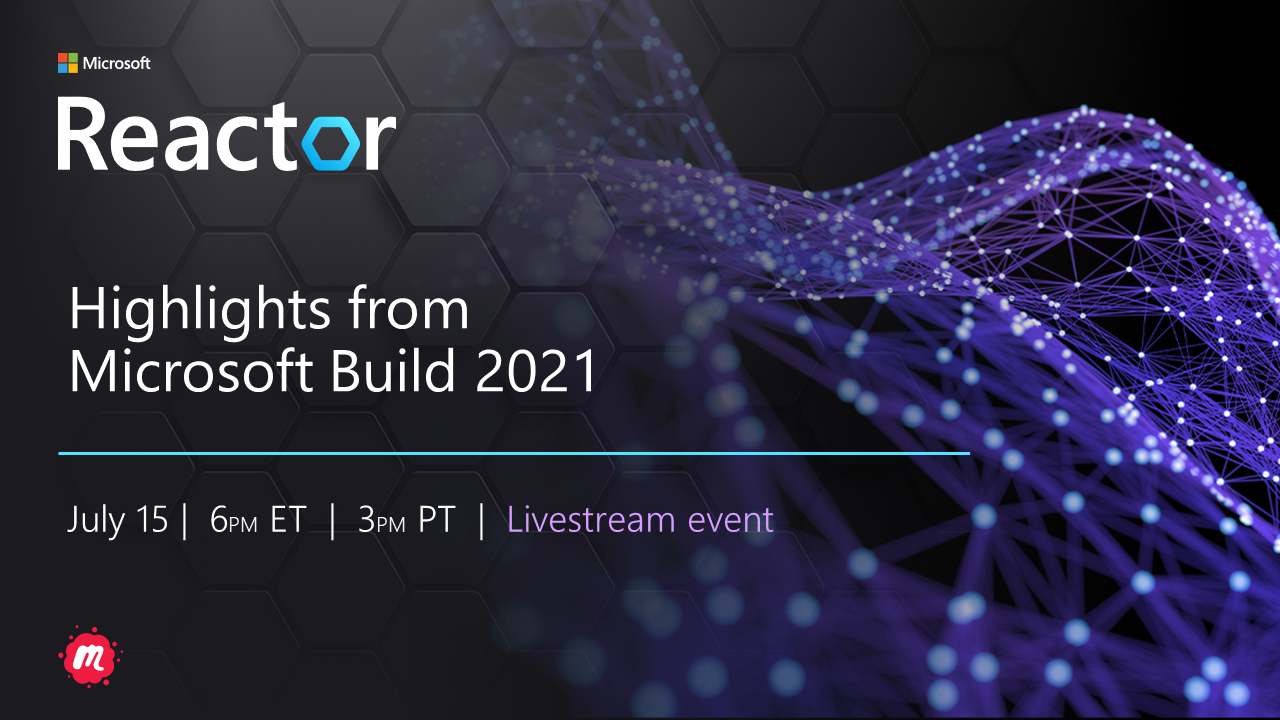
I’m happy to announce a Highlights from Microsoft Build 2021 digital event next Thursday, July 15. Please join me and other local experts as we look to provide key insights from the event that will help you expand your skillset, find technical solutions, and innovate for the challenges of tomorrow.
Today we’re pleased to announce the availability of Plato.Core, a port of our popular Plato.NET library for .NET to the .NET Core framework.
Plato.Core supports the following features:
Async/Await
Object Mapper
Memory Cache
Configuration
Messaging
Security
Serializers
Support for ActiveMQ
Support for RabbitMQ
Support for Redis cache
To get started, search for Plato.NetCore on NuGet.org from within Visual Studio and Visual Studio Code. Take a look and let us know what you think and please contribute!
Today we’re pleased to announce the availability of Plato.Core, a port of our popular Plato.NET library for .NET to the .NET Core framework.
Plato.Core supports the following features:
Async/Await
Object Mapper
Memory Cache
Configuration
Messaging
Security
Serializers
Support for ActiveMQ
Support for RabbitMQ
Support for Redis cache
To get started, search for Plato.NetCore on NuGet.org from within Visual Studio and Visual Studio Code. Take a look and let us know what you think and please contribute!




 The Flying Maverick