Category: Events

.NETAIAzureCloudCommunity

Festive Tech Calendar 2024 YouTube playlist

Enjoy!

Reference

https://festivetechcalendar.com/

AzureDeveloperEvents

Microsoft Build 2024 Book of News

What is the Book of News? The Microsoft Build 2024 Book of News is your guide to the key news items announced at Build 2024.

As expected there is a lot of focus on Azure and AI, followed by Microsoft 365, Security, Windows, and Edge & Bing. This year the book of news is interactive instead of being a PDF.

Some of my favourite announcements

Azure Cloud Native and Application Platform

Azure Functions

Microsoft Azure Functions is launching several new features to provide more flexibility and extensibility to customers in this era of AI.

Features now in preview include:

  • A Flex Consumption plan that will give customers more flexibility and customization without compromising on available features to run serverless apps.
  • Extension for Microsoft Azure OpenAI Service that will enable customers to easily infuse AI in their apps. Customers will be able to use this extension to build new AI-led apps like retrieval-augmented generation, text completion and chat assistant.
  • Visual Studio Code for the Web will provide a browser-based developer experience to make it easier to get started with Azure Functions. This feature is available for Python, Node and PowerShell apps in the Flex Consumption hosting plan.

Features now generally available include:

  • Azure Functions on Azure Container Apps lets developers use the Azure Container Apps environment to deploy multitype services to a cloud-native solution designed for centralized management and serverless scale.
  • Dapr extension for Azure Functions enables developers to use Dapr’s powerful cloud native building block APIs and a large array of ecosystem components in the native and friendly Azure Functions triggers and bindings programming model. The extension is available to run on Azure Kubernetes Service and Azure Container Apps.

Azure Container Apps

Microsoft Azure Container Apps will include dynamic sessions, in preview, for AI app developers to instantly run large language model (LLM)-generated code or extend/customize software as a service (SaaS) apps in an on-demand, secure sandbox.

Customers will be able to mitigate risks to their security posture, leverage serverless scale for their apps and save months of development work, ongoing configurations and management of compute resources that reduce their cost overhead. Dynamic sessions will provide a fast, sandboxed, ephemeral compute suitable for running untrusted code at scale.

Additional new features, now in preview, include:

  • Support for Java: Java developers will be able to monitor the performance and health of apps with Java metrics such as garbage collection and memory usage.
  • Microsoft .NET Aspire dashboard: With dashboard support for .NET Aspire in Azure Container Apps, developers will be able to access live data about projects and containers in the cloud to evaluate the performance of .NET cloud-native apps and debug errors.

Azure App Service

Microsoft Azure App Service is a cloud platform to quickly build, deploy and run web apps, APIs and other components. These capabilities are now in preview:

  • Sidecar patterns is a way to add extra features to the main app, such as logging, monitoring and caching, without changing the app code. Users will be able to run these features alongside the app and it is supported for both source code and container-based deployments.
  • WebJobs will be integrated with Azure App Service, which means they will share the same compute resources as the web app to help save costs and ensure consistent performance. WebJobs are background tasks that run on the same server as the web app and can perform various functions, such as sending emails, executing bash scripts and running scheduled jobs.
  • GitHub Copilot skills for Azure Migrate will enable users to ask questions like, “Can I migrate this app to Azure?” or “What changes do I need to make to this code?” to get answers and recommendations from Azure Migrate. GitHub Copilot licenses are sold separately.

These capabilities are now generally available:

  • Automatic scaling continuously adjusts the number of servers that run apps based on a combination of demand and server utilization, without any code or complex scaling configurations. This helps users handle dynamically changing site traffic without over-provisioning or under-provisioning the app’s server resources.
  • Availability zones are isolated locations within an Azure region that provide high availability and fault tolerance. Enabling availability zones lets users take advantage of the increased service level agreement (SLA) of 99.99%. For more information, reference the SLA for App Service.
  • TLS 1.3 encryption, the latest version of the protocol that secures communication between apps and the clients, offers faster and more secure connections, as well as better compatibility with modern browsers and devices.

Azure Static Web Apps

To help customers deliver more advanced capabilities, Microsoft Azure Static Web Apps will offer a dedicated pricing plan, now in preview, that supports enterprise-grade features for enhanced networking and data storage. The dedicated plan for Azure Static Web Apps will utilize dedicated compute capacity and will enable:

  • Network isolation to enhance security.
  • Data residency to help customers comply with data management policies and requirements.
  • Enhanced quotas to allow for more custom domains within an app service plan.
  • “Always-on” functionality for Azure Static Web Apps managed functions, which provide built-in API endpoints to connect to backend services.

Azure Logic Apps

Microsoft Azure Logic Apps is a cloud platform where users can create and run automated workflows with little to no code. Updates to the platform include:

An enhanced developer experience:

  • Improved onboarding experience in Microsoft Visual Studio Code: A simplified extension installation experience and improvements on project start and debugging are now generally available.
  • Logic Apps Standard deployment scripting tools in Visual Studio Code: This feature will simplify the process of setting up a continuous integration/continuous delivery (CI/CD) process for Logic Apps Standard by providing support in the tooling to generalize common metadata files and automate the creation of infrastructure scripts to streamline the task of preparing code for automated deployments. This feature is in preview.
  • Support for Zero Downtime deployment scenarios: This will enable Zero Downtime deployment scenarios for Logic Apps Standard by providing support for deployment slots in the portal. This update is in preview.

Expanded functionality and compatibility with Logic Apps Standard:

  • .NET Custom Code Support: Users will be able to extend low-code workflows with the power of .NET 8 by authoring a custom function and calling from a built-in action within the workflow. This feature is in preview.
  • Logic Apps connectors for IBM mainframe and midranges: These connectors allow customers to preserve the value of their workloads running on mainframes and midranges by allowing them to extend to the Azure Cloud without investing more resources in the mainframe or midrange environments using Azure Logic Apps. This update is generally available.
  • Other updates, in preview, include Azure Integration account enhancements and Logic Apps monitoring dashboard.

Azure API Center

Microsoft Azure API Center, now generally available, provides a centralized solution to manage the challenges of API sprawl, which is exacerbated by the rapid proliferation of APIs and AI solutions. The Azure API Center offers a unified inventory for seamless discovery, consumption and governance of APIs, regardless of their type, lifecycle stage or deployment location. This enables organizations to maintain a complete and current API inventory, streamline governance and accelerate consumption by simplifying discovery.

Azure API Management

Azure API Management has introduced new capabilities to enhance the scalability and security of generative AI deployments. These include the Microsoft Azure OpenAI Service token limit policy for fair usage and optimized resource allocation, one-click import of Azure OpenAI Service endpoints as APIs, a Load Balancer for efficient traffic distribution and a Circuit breaker to protect backend services.

Other updates, now generally available, include first-class support for OData API type, allowing easier publication and security of OData APIs, and full support for gRPC API type in self-hosted gateways, facilitating the management of gRPC services as APIs.

Azure Event Grid

Microsoft Azure Event Grid has new features that are tailored to customers who are looking for a pub-sub message broker that can enable Internet of Things (IoT) solutions using MQTT protocol and can help build event-driven apps. These capabilities enhance Event Grid’s MQTT broker capability, make it easier to transition to Event Grid namespaces for push and pull delivery of messages, and integrate new sources. Features now generally available include:

  • Use the Last Will Testament feature, in compliance with MQTT v5 and MQTT v.3.1.1 specifications, so apps receive notifications when clients get disconnected, enabling management of downstream tasks to prevent performance degradation.
  • Create data pipelines that utilize both Event Grid Basic resources and Event Grid Namespace Topics (supported in Event Grid Standard). This means customers can utilize Event Grid namespace capabilities, such as MQTT broker, without needing to reconstruct existing workflows.
  • Support new event sources, such as Microsoft Entra ID and Microsoft Outlook, leveraging Event Grid’s support for the Microsoft Graph API. This means customers can use Event Grid for new use cases, like when a new employee is hired or a new email is received, to process that information and send to other apps for more action.

Azure Data Platform

Real-Time Intelligence in Microsoft Fabric

The new Real-Time Intelligence within Microsoft Fabric will provide an end-to-end software as a service (SaaS) solution that will empower customers to act on high volume, time-sensitive and highly granular data in a proactive and timely fashion to make faster and more-informed business decisions. Real-Time Intelligence, now in preview, will empower user roles such as everyday analysts with simple low-code/no-code experiences, as well as pro developers with code-rich user interfaces.

Features of Real-Time Intelligence will include:

  • Real-Time hub, a single place to ingest, process and route events in Fabric as a central point for managing events from diverse sources across the organization. All events that flow through Real-Time hub will be easily transformed and routed to any Fabric data stores.
  • Event streams that will provide out-of-the-box streaming connectors to cross cloud sources and content-based routing that helps remove the complexity of ingesting streaming data from external sources.
  • Event house and real-time dashboards with improved data exploration to assist business users looking to gain insights from terabytes of streaming data without writing code.
  • Data Activator that will integrate with the Real-Time hub, event streams, real-time dashboards and KQL query sets, to make it seamless to trigger on any patterns or changes in real-time data.
  • AI-powered insights, now with an integrated Microsoft Copilot in Fabric experience for generating queries, in preview, and a one-click anomaly detection experience, allowing users to detect unknown conditions beyond human scale with high granularity in high-volume data, in private preview.
  • Event-Driven Fabric will allow users to respond to system events that happen within Fabric and trigger Fabric actions, such as running data pipelines.

New capabilities and updates to Microsoft Fabric

Microsoft Fabric, the unified data platform for analytics in the era of AI, is a powerful solution designed to elevate apps, whether a user is a developer, part of an organization or an independent software vendor (ISV). Updates to Fabric include:

  • Fabric Workload Development Kit: When building an app, it must be flexible, customizable and efficient. Fabric Workload Development Kit will make this possible by enabling ISVs and developers to extend apps within Fabric, creating a unified user experience.This feature is now in preview.
  • Fabric Data Sharing feature: Enables real-time data sharing across users and apps. The shortcut feature API allows seamless access to data stored in external sources to perform analytics without the traditional heavy integration tax. The new Automation feature now streamlines repetitive tasks resulting in less manual work, fewer errors and more time to focus on the growth of the business. These features are now in preview.
  • GraphQL API and user data functions in Fabric: GraphQL API in Fabric is a savvy personal assistant for data. It’s a RESTful API that will let developers access data from multiple sources within Fabric, using a single query. User data functions will enhance data processing efficiency, enabling data-centric experiences and apps using Fabric data sources like lakehouses, data warehouses and mirrored databases using native code ability, custom logic and seamless integration.These features are now in preview.
  • AI skills in Fabric: AI skills in Fabric is designed to weave generative AI into data specific work happening in Fabric. With this feature, analysts, creators, developers and even those with minimal technical expertise will be empowered to build intuitive AI experiences with data to unlock insights. Users will be able to ask questions and receive insights as if they were asking an expert colleague while honoring user security permissions.This feature is now in preview.
  • Copilot in Fabric: Microsoft is infusing Fabric with Microsoft Azure OpenAI Service at every layer to help customers unlock the full potential of their data to find insights. Customers can use conversational language to create dataflows and data pipelines, generate code and entire functions, build machine learning models or visualize results. Copilot in Fabric is generally available in Power BI and available in preview in the other Fabric workloads.

Azure Cosmos DB

Microsoft Azure Cosmos DB, the database designed for AI that allows creators to build responsive and intelligent apps with real-time data ingested and processed at any scale, has several key updates and new features that include:

  • Built-in vector database capabilities: Azure Cosmos DB for NoSQL will feature built-in vector indexing and vector similarity search, enabling data and vectors to be stored together and to stay in sync. This will eliminate the need to use and maintain a separate vector database. Powered by DiskANN, available in June, Azure Cosmos DB for NoSQL will provide highly performant and highly accurate vector search at any scale. This feature is now in preview.
  • Serverless to provisioned account migration: Users will be able to transition their serverless Azure Cosmos DB accounts to provisioned capacity mode. With this new feature, transition can be accomplished seamlessly through the Azure portal or Azure command-line interface (CLI). During this migration process, the account will undergo changes in-place and users will retain full access to Azure Cosmos DB containers for data read and write operations.This feature is now in preview.
  • Cross-region disaster recovery: With disaster recovery in vCore-based Azure Cosmos DB for MongoDB a cluster replica can be created in another region. This cluster replica will be continuously updated with the data written in the primary region. In a rare case of outage in the primary region and primary cluster unavailability, this replica can be promoted to become the new read-write cluster in another region. Connection string is preserved after such a promotion, so that apps can continue to read and write to the database in another region using the same connection string. This feature is now in preview.
  • Azure Cosmos DB Vercel integration: Developers building apps using Vercel can now connect easily to an existing Azure Cosmos DB database or create new Azure Try Cosmos DB accounts on the fly and integrate them to their Vercel projects. This integration improves productivity by creating apps easily with a backend database already configured. This also helps developers onboard to Azure Cosmos DB faster. This feature is now generally available.
  • Go SDK for Azure Cosmos DB: The Go SDK allows customers to connect to an Azure Cosmos DB for NoSQL account and perform operations on databases, containers and items. This release brings critical Azure Cosmos DB features for multi-region support and high availability to Go, such as the ability to set preferred regions, cross-region retries and improved request diagnostics. This feature is now generally available.

Click here to read the Microsoft Build 2024 Book of News!

Enjoy!

AzureEventsLearning

Microsoft Ignite 2023 Book of News

What is the Book of News? The Microsoft Ignite 2023 Book of News is your guide to the key news items that are announced at Ignite 2023.

AI, Copilot and Microsoft Fabric will have an overarching theme at this year’s conference as you will see throughout the sessions and announcements.

Some of my favourite announcements

Azure Cloud Native and Application Platform

Azure App Service

  • Single subnet support for multiple App Service plans is now generally available. Network administrators gain substantial reduction in management overhead thanks to the new capability enabling multiple service plans to connect to a single subnet in a customer’s virtual network.
  • WebJobs on Linux is now in preview. WebJobs is a popular feature of Azure App Service that enables users to run background tasks in the Azure App Service without any additional cost. Previously available on Windows, it will extend to Linux, enabling customers to run background or recurring tasks and do things like send email reports or perform image or file processing.
  • Extensibility support on Linux is now in preview. Previously available on Windows, it will allow Linux web apps to take advantage of third-party software services on Azure and connect to Azure Native ISV services more easily.
  • gRPC, a high-performance, open-source universal RPC framework that now provides full bi-directional streaming support and increased messaging performance over HTTP/2 for web apps running on App Service for Linux is generally available.

Azure Functions

  • Azure Functions now supports .NET 8 for applications using the isolated worker model. Support is now available for Windows and Linux on the consumption, elastic premium and application service plan hosting options. This update is generally available.
  • Flex Consumption Plan is a new Azure Functions hosting plan that will build on the consumption, pay-for-what’s-used, serverless billing model. It will provide more flexibility and customizability without compromising on available features. New capabilities will include fast and large elastic scale, instance size selection, private networking, availability zones and high concurrency control. Users can request access to the private preview.

Azure Container Apps

  • Dedicated GPU workload profiles: Users will be able to run machine learning models with Azure Container Apps as a target compute platform to build event driven intelligent applications to train models or derive data-driven insights. This feature is in preview.
  • Azure Container Apps landing zone accelerator: Simplifies building of a production-grade secured infrastructure at an enterprise scale to deploy fully managed, cloud-native apps and microservices. This feature is generally available.
  • Azure Container Apps code to cloud: Users will be able to focus on code and quickly take an application from source to cloud without the need to understand containers or how to package application code for deployment. This feature is in preview.
  • Vector database add-ins: Three of the most popular open-source vector database variants, Qdrant, Milvus and Weaviate, are now available in preview as add-ins for developers to get started in a fast and affordable way.

Azure Kubernetes Service

  • The release of Kubernetes AI toolchain operator automates LLM model deployment on AKS across available CPU and GPU resources by selecting optimally sized infrastructure for the model. It makes it possible to easily split inferencing across multiple lower-GPU-count VMs, increasing the number of Azure regions where workloads can run, eliminating wait times for higher-GPU-count VMs and lowering overall cost. Customers can also choose from preset models with images hosted by AKS, significantly reducing overall inference service setup time.
  • Additionally, Azure Kubernetes Fleet Manager enables multi-cluster and at-scale scenarios for AKS clusters. Platform admins who are managing Kubernetes fleets with many clusters often face challenges staging their updates in a safe and predictable way. This allows admins to orchestrate updates across multiple clusters by using update runs, stages and groups. This is now generally available.

Azure Event Grid

  • Azure Event Grid now supports additional capabilities to help customers capitalize on growing industry scenarios. A key part of this new functionality is the ability to deliver publish-subscribe messaging at scale, which enables flexible consumption patterns for data over HTTP and MQTT protocols. This capability is now generally available.
  • Pull delivery for event-driven architectures: This allows customers to process events from highly secure environments without configuring a public end point, controlling the rate and volume of messages consumed, while supporting much larger throughput. This feature is generally available.
  • Push delivery to Azure Event Hubs: Event Grid namespaces will support the ability to push events to Azure Event Hubs at high scale through a namespace topic subscription. This enables the development of more distributed applications to send discrete events to ingestion pipelines. This feature is in preview.
  • Increased throughput units: To help customers scale to meet the demands of these new scenarios, Event Grid has also increased the number of throughput units available in an Event Grid namespace to 40, meeting the needs of more data-intensive scenarios by providing more capacity. This feature is generally available.

Azure Communication Services

  • Azure AI Speech integration into Azure Communication Services Call Automation workflows, generally available in November, will enable AI-assisted experiences for customers calling into a business.
  • Azure Communication Services job router, generally available in early December, will simplify the development of routing capabilities for inbound customer communications and steer customers to the most suitable point of contact in a business.

Azure API Management

  • API Management’s Credential Manager, now generally available, simplifies the management of authentication and authorization for both professional developers and citizen developers.
  • Defender for APIs, a new offering as part of Microsoft Defender for Cloud – a cloud-native application protection platform (CNAPP), is now generally available. Natively integrating with Azure API Management, security admins gain visibility into the Azure business-critical APIs, understand and improve their security posture, prioritize vulnerability fixes and detect and respond to active runtime threats within minutes using machine learning-powered anomalous and suspicious API usage detections.

Azure Migrate

  • The Azure Migrate application and code assessment, now generally available, complements the Azure Migrate assessment and migration tool to help modernize and re-platform large-scale .NET and Java applications through detailed code and application scanning and dependencies detections. The tool offers a comprehensive report with recommended code changes for customers to apply a broad range of code transformations with different use cases and code patterns.

Azure Data Platform

General

  • Amazon S3 shortcuts, now generally available, allow organizations to unify their data in Amazon S3 with their data in OneLake. With this update, data engineers can create a single virtualized data lake for their entire organization across Amazon S3 buckets and OneLake – without the latency of copying data from S3 and without changing overall data ownership.
  • Azure Data Lake Storage Gen2 (ADLS Gen2) shortcuts are now generally available, empowering data engineers to connect to data from external data lakes in ADLS Gen2 into OneLake through a live connection with target data.

Azure SQL

  • Several new features and updates for Azure SQL will make the offering more cost-efficient, reliable and secure.

Microsoft Fabric

  • Microsoft Fabric, an integrated and simplified experience for a data estate on an enterprise-grade data foundation, is now generally available. Fabric enables persistent data governance and a single capacity pricing model that scales with growth, and it’s open at every layer with no proprietary lock-ins. Fabric integrates Power BI, Data Factory and the next generation of Synapse to offer customers a price-effective and easy-to-manage modern analytics solution for the era of AI.
  • Microsoft 365 data is now able to natively integrate to OneLake in the Delta Parquet format, the optimal format for data analysis. Microsoft 365 data was previously offered only in JSON format. With this new integration, Microsoft 365 data will be seamlessly joined with other data sources in OneLake, enabling access to a suite of analytical experiences for organizations to transform and gain insight from their data. This also means that AI capabilities built using Microsoft Fabric notebooks will now directly access Microsoft 365 data within OneLake. This update is in preview.
  • Microsoft Fabric is being infused with Azure OpenAI Service at every layer to help customers unlock the full potential of their data, enabling developers to leverage the power of generative AI against their data and assisting business users to find insights in their data. This feature is in preview.

Azure Cosmos DB

  • Dynamic scaling per partition/region, now in preview for new Azure Cosmos DB accounts, will allow customers to optimize for scale and cost in situations where partitioning is used to scale individual containers in a database to meet the performance needs of applications, or where multi-region configuration of Azure Cosmos DB is used for global distribution of data.
  • Microsoft Copilot for Azure integration in Azure Cosmos DB, now in preview, will bring AI into the Azure Cosmos DB developer experience. Specifically, this release enables developers to turn natural language questions into Azure Cosmos DB NoSQL queries in the query editor of Azure Cosmos DB Data Explorer. This new feature will increase developer productivity by generating queries and written explanations of the query operations as they ask questions about their data.
  • Azure Cosmos DB for MongoDB vCore, now generally available, allows developers to build intelligent applications in Azure with MongoDB compatibility. With Azure Cosmos DB for MongoDB vCore, developers can enjoy the benefits of native Azure integrations, low total cost of ownership and the familiar vCore architecture when migrating existing applications or building new ones. Azure Cosmos DB for MongoDB vCore is also introducing a free tier, which is a developer-friendly way to explore the platform’s capabilities without any cost. Learn more about the free tier.
  • In addition, a new Azure AI Advantage offer will help customers realize the value of Azure Cosmos DB and Azure AI together. Benefits include:
    • Savings up to 40,000 RU/s for three months on Azure Cosmos DB when using GitHub Copilot or Azure AI, including Azure OpenAI Service.
    • World-class infrastructure and security to grow business and safeguard data.
    • Enhanced reliability of generative AI applications by leveraging the speed of Azure Cosmos DB to retrieve and process data.
  • Vector search in Azure Cosmos DB MongoDB vCore, now generally available, allows developers to seamlessly integrate their AI-based applications with the data stored in Azure Cosmos DB. Vector search enables users to efficiently store, index and query high-dimensional vector data, eliminating the need to transfer the data to more expensive alternatives for vector search capabilities, such as vector databases.

SQL Server

  • Monitoring for SQL Server enabled by Azure Arc, now in preview, will allow customers to gain critical insights into their entire SQL Server estate across on-premises datacenter and cloud, optimize for database performance and diagnose problems faster. With this monitoring tool, customers will be empowered to switch from a reactive operation mode to a proactive one, further improving database uptime while reducing routine workloads.
  • Enhanced high availability and disaster recovery (HA/DR) management for SQL Server enabled by Azure Arc is now in preview. With Azure Arc, customers can now improve SQL Server business continuity and consistency by viewing and managing Always On availability groups, failover cluster instances and backups directly from the Azure portal. This new capability will provide customers with better visibility and a much easier and more flexible way to configure critical database operations.
  • Extended Security Updates for SQL Server enabled by Azure Arc is now generally available. Extended Security Updates for SQL Server, which provide critical security updates for up to three years after the end of extended support, are now available as a service through Azure Arc. With the Extended Security Update service, customers running older SQL Server versions on-premises or in multicloud environments can manage security patches from the Azure portal. Extended Security Updates enabled by Azure Arc give financial flexibility with a pay-as-you-go subscription model.

Azure Infrastructure

AI

  • Custom-built silicon for AI and enterprise workloads in the Microsoft Cloud
  • Today, Microsoft is announcing new custom silicon that complements Microsoft’s offerings with industry partners. The two new chips, Microsoft Azure Maia and Microsoft Azure Cobalt, were built with a holistic view of hardware and software systems to optimize performance and price.
  • Microsoft Azure Maia is an AI Accelerator chip designed to run cloud-based training and inferencing for AI workloads, such as OpenAI models, Bing, GitHub Copilot and ChatGPT.
  • Microsoft Azure Cobalt is a cloud-native chip based on Arm architecture optimized for performance, power efficiency and cost-effectiveness for general-purpose workloads.
  • Azure Boost is now generally available
  • One of Microsoft Azure’s latest and most significant infrastructure improvements, Azure Boost, is now generally available. Azure Boost enables greater network and storage performance at scale, improves security, and reduces servicing impact by moving virtualization processes traditionally performed by the host servers, such as networking, storage and host management, onto purpose-built hardware and software optimized for these processes. This innovation allows Microsoft to achieve the fastest remote and local storage performances in the market today, with a remote storage performance of 12.5 Gbps (gigabits per second) throughput and 650K IOPS (input/output operations per second) and a local storage performance of 17.3 Gbps throughput and 3.8M IOPS.
  • ND MI300 v5 virtual machines with AMD chips optimized for generative AI workloads
  • The ND MI300 v5 virtual machines are designed to accelerate the processing of AI workloads for high-range AI model training and generative inferencing, and will feature AMD’s latest GPU, the AMD Instinct MI300X.
  • NC H100 v5 virtual machines with the latest NVIDIA GPUs
  • The new NC H100 v5 Virtual Machine (VM) Series, in preview, is built on the latest NVL variant of the NVIDIA Hopper 100 (H100), which will offer greater memory per GPU. The new VM series will provide customers with greater performance, reliability and efficiency for mid-range AI training and generative AI inferencing. By maintaining more memory per GPU in the VM, customers increase data processing efficiency and enhance overall workload performance.

Azure Migrate

  • Azure Migrate, the service used to migrate to and modernize in Azure, is introducing discovery, business case analysis and assessment support for new workloads. This allows customers to analyze their configuration and compatibility for new use cases so they can determine appropriately sized Azure instances at optimal cost and without blockers.
  • Specific features, in preview, include Spring apps assessment, business case with management costs, business case and assessment with security and Windows and SQL ESU in business case and Web apps assessment, which is generally available.

Azure IoT Operations

Azure IoT Operations is a new addition to the Azure IoT portfolio that will offer a unified, end-to-end Microsoft solution that digitally transforms physical operations seamlessly from the cloud to the edge.

That unified approach consists of the following:

  • Management plane: One control plane to secure and govern assets and workloads across cloud to edge with Azure Arc.
  • Application development: Consistently build and deploy apps anywhere, in the cloud or at the edge.
  • Cloud-to-edge data plane: Seamless integration at the data level from asset to cloud and back again.
  • Common infrastructure: Customers can connect investments in the cloud with their on-premises resources.

Learn more about Accelerating Industrial Transformation with Azure IoT Operations

Azure Management and Operations

Azure Chaos Studio

Azure Chaos Studio, now generally available, provides a fully managed experimentation platform for discovering challenging issues through experiment templates, dynamic targets and a more guided user interface.

Azure AI Services

Azure AI Studio

  • Microsoft is launching the preview of its unified AI platform, Azure AI Studio, which will empower all organizations and professional developers to innovate and shape the future with AI.

Azure AI Vision

  • Liveness functionality and Vision SDK: Liveness functionality will help prevent face recognition spoofing attacks and conforms to ISO 30107-3 PAD Level 2. Vision SDK for Face will enable developers to easily add face recognition and liveness to mobile applications. Both features are in preview.
  • Image Analysis 4.0: This API introduces cutting-edge Image Analysis models, encompassing image captioning, OCR, object detection and more, all accessible through a single, synchronous API endpoint. Notably, the enhanced OCR model boasts improved accuracy for both typed and handwritten text in images. Image Analysis 4.0 is generally available.
  • Florence foundation model: Trained with billions of text-image pairs and integrated as cost-effective, production-ready computer vision services in Azure AI Vision, this improved feature enables developers to create cutting-edge, market-ready, responsible computer vision applications across various industries. Florence foundation model is generally available.

Azure Open AI Service

  • DALL·E 3: Imagine an AI model that can generate images from text descriptions. DALL·E 3 is a remarkable AI model that does just that. Users describe an image, and DALL·E 3 will be able to create it. DALL·E 3 is in preview.
  • GPT-3.5 Turbo model with a 16k token prompt length and GPT-4 Turbo: The latest models in Azure OpenAI Service will enable customers to extend prompt length and bring even more control and efficiency to their generative AI applications. Both models will be available in preview at the end of November 2023.
  • GPT-4 Turbo with Vision (GPT-4V): When integrated with Azure AI Vision, GPT-4V will enhance experiences by allowing the inclusion of images or videos along with text for generating text output, benefiting from Azure AI Vision enhancement like video analysis. GPT-4V will be in preview by the end of 2023.
  • GPT-4 updates: Azure OpenAI Service has also rolled out updates to GPT-4, including the ability for fine-tuning. Fine-tuning will allow organizations to customize the AI model to better suit their specific needs. It’s akin to tailoring a suit to fit perfectly, but in the world of AI. Updates to GPT-4 are in preview.

Azure AI Video Indexer

  • Video-to-text summary: Users will be able to extract the essence of video content and generate concise and informative text summaries. The advanced algorithm segments videos into coherent chapters, leveraging visual, audio and text cues to create sections that are easily accommodated in large language model (LLM) prompt windows. Each section contains essential content, including transcripts, audio events and visual elements. This is ideal for creating video recaps, training materials or knowledge-sharing.
  • Efficient Video Content Search: Users will be able to transform video content into a searchable format using LLMs and Video Indexer’s insights. By converting video insights into LLM-friendly prompts, the main highlights are accessible for effective searching. Scene segmentation, audio events and visual details further enhance content division, allowing users to swiftly locate specific topics, moments or details within extensive video.

This year’s Ignite was packed with lots of new announcements and features that I can’t wait to start using in my applications.

Enjoy!

Click here to read the Microsoft Ignite 2023 Book of News!

AIAzureEventsLearning

Microsoft Build 2023 Book of News

What is the Book of News? The Microsoft Build 2023 Book of News is your guide to the key news items that are announced at Build 2023.

As expected there is a lot of focus on Azure and AI, followed by Microsoft 365, Security, Windows, and Edge & Bing. This year the book of news is interactive instead of being a PDF.

Some of my favourite announcements

Azure Cloud Native and Application Platform

Azure API Management

  • Azure API Center: A new service that will enable organizations to centralize and manage their portfolio of APIs, regardless of type, life cycle or deployment location. This update is in preview. Learn more about updates to Azure API Center.
  • WebSocket API passthrough: Allows users to manage, protect, observe and expose WebSocket APIs running in container environments with the API Management self-hosted gateway container. This is now generally available. Learn more about WebSocket API passthrough.
  • Self-hosted gateway support for Azure Active Directory (Azure AD) tokens: Users will be able to secure communication between the self-hosted gateway to Azure to download configuration using Azure AD tokens. This allows customers to avoid manually refreshing a gateway token that expires every 30 days. This update is generally available.

Azure Event Grid

  • Leverage HTTP to enable “pull” delivery of discrete events to provide more flexible consumption patterns at high scale.
  • Enable publish-subscribe via the MQTT protocol, enabling bidirectional communication at scale between Internet of Things (IoT) devices and cloud-based services.
  • Enables routing MQTT data to other Azure services and third-party services for further data analytics and storage.

These updates are now in preview. Learn more about public preview of MQTT protocol and pull message delivery in Azure Event Grid.

Azure Functions

  • Deploy containerized Azure Functions in an Azure Container Apps environment to quickly build event-driven, cloud-native apps leveraging built-in Dapr integrations for distributed, microservice-based serverless apps.
  • Maximize developer velocity using Azure Functions integrated programming model, write code using preferred programming language or framework that Azure Functions supports and get the built-in service integrations with triggers and bindings for a first-class, event-driven, cloud-native experience.
  • Run Azure Functions alongside other microservices, APIs, websites, workflows or any containerized app using an Azure Container Apps environment built for robust serverless scale, microservices and fully managed infrastructure.

Azure Kubernetes Service

  • Long-term support is now generally available, starting with Kubernetes 1.27. Once enabled, this provides a two-year support window for a specific version of Kubernetes. Kubernetes delivers new releases every three to four months to keep up with the pace of innovation in the cloud-native world. To give enterprises more control over their environment, long-term support for Kubernetes enables customers to stay on the same release for two years – twice as long as what’s possible today. This is a long-awaited development in the cloud-native, open-source community for customers who need the additional option for a longer upgrade runway with continued support and security updates.
  • Transactable Kubernetes apps, now generally available, allow AKS customers to explore a vibrant ecosystem of first- and third-party Kubernetes-ready solutions from Azure Marketplace, and purchase and securely deploy them on AKS with easy click-through deployments. Conveniently integrated with Azure billing, these solutions are ready to use, taking advantage of all the benefits of running on a cloud-native platform like AKS.
  • Confidential containers in AKS, now in preview, is a first-party offering that will allow teams to run standard unmodified containers, aligned with the Kata Confidential Containers open-source project, to achieve zero trust operator deployments with AKS. These containers can be integrated with the typical services used by apps running on AKS for monitoring, logging, etc. in a trusted execution environment (TEE), with each pod assigned its own memory encryption key, providing hardware-based confidentiality and integrity protections, underscoring Microsoft’s focus on enterprise-readiness for these workloads. Learn more about confidential containers in AKS.
  • The multi-cluster update in Azure Kubernetes Fleet Manager (Fleet), in preview, will enable multi-cluster and at-scale scenarios for AKS clusters. The new multi-cluster update feature gives teams the ability to orchestrate planned updates across multiple clusters for a consistent environment.

Azure Communication Services

  • A new set of application programming interfaces (APIs), generally available next month, will help developers build server-based, intelligent calling workflows into their apps and simplify the delivery of personalized customer engagement with additional AI capabilities from Azure Cognitive Services.
  • Call automation interoperability into Microsoft Teams will be in preview next month for businesses that want to connect experts who use Teams into existing customer service calls. From daily appointment bookings and order updates to complex customer outreach for marketing and customer service, call automation with Azure Communication Services is changing the landscape of customer engagement.

Azure Data Platform

Microsoft Fabric

  • Microsoft Fabric, now in preview, delivers an integrated and simplified experience for all analytics workloads and users on an enterprise-grade data foundation. It brings together Power BI, Data Factory and the next generation of Synapse in a unified software as a service (SaaS) offering to give customers a price-effective and easy-to-manage modern analytics solution for the era of AI. Fabric has experiences for all workloads and data professionals in one place – including data integration, data engineering, data warehousing, data science, real-time analytics, applied observability and business intelligence – to increase productivity like never before.
  • To further enable organizations to accelerate value creation with their data, Microsoft is integrating Copilot in Microsoft Fabric, in preview soon, to enable the use of natural language and a chat experience to generate code and queries, create AI plugins using a low/no-code experience, enable custom Q&A, tailor semantics and components within the plugin and deploy to Microsoft Teams, Power BI and web. With AI-driven insights, customers can focus on telling the right data story and let Copilot do the heavy lifting.
  • Organizational data is hosted on Microsoft’s unified foundation, OneLake, which provides a single source of truth and reduces the need to extract, move or replicate data, helping eliminate rogue data sprawl. Fabric also enables persistent data governance and a single capacity pricing model that scales with growth, and it’s open at every layer with no proprietary lock-ins. Deep integrations with Microsoft 365, Teams and AI Copilot experiences accelerate and scale data value creation for everyone. From data professionals to non-technical business users, Fabric has role-tailored experiences to empower everyone to unlock more value from data.

Azure Cosmos DB

  • ​Burst capacity: Developers can achieve better performance and productivity with burst capacity, which allows customers to utilize the idle throughput capacity of their database or container to handle traffic spikes. Databases using standard provisioned throughput with burst capacity enabled will be able to maintain performance during short bursts when requests exceed the throughput limit. This gives customers a cushion if they’re under-provisioned and allows them to experience fewer rate-limited requests. This update is generally available.
  • ​Hierarchical partition keys: More efficient partitioning strategies and improved performance are made possible by hierarchical partition keys, which enable up to three partition keys to be used instead of one. This removes the performance trade-offs that developers often face when having to choose a single partition key and enables more optimal data distribution and high scale. This is generally available.
  • ​Materialized Views for Azure Cosmos DB for NoSQL: With Materialized Views, now in preview, users will be able to create and maintain secondary views of their data in containers that are used to serve queries that would be too expensive to serve with an existing container. Materialized Views can easily create and maintain data between two containers.
  • ​Azure Cosmos DB “All versions and deletes” change feed mode: Developers will be able to get a full view of changes to items occurring within the continuous backup retention period of their account, saving time and reducing app complexity. This is in preview.
  • ​.NET and Java SDKs Telemetry + App Insights: Monitoring apps will be easier with this update, now in preview. The Azure Cosmos DB .NET and Java SDKs support distributed tracing to help developers easily monitor their apps and troubleshoot issues, thereby improving performance and developer productivity.

Windows Platform

  • After listening to developer feedback, Microsoft created a home for developers on Windows with a renewed focus on productivity and performance across all stages of the development lifecycle. These features, now in preview, include:
  • Dev Home will allow users to quickly set up their machines, connect to GitHub and monitor and manage workflows in one central location. Dev Home is open source and extensible, allowing users to enhance their experience with a customizable dashboard and the tools they need to be successful. Users can also add GitHub widgets to track projects and system widgets to track CPU and GPU performance.
  • Windows Package Manager now includes WinGet configuration, which handles the setup requirements for an ideal development environment on a Windows machine using a WinGet configuration file, reducing device setup time from days to hours. Developers no longer need to worry about searching for the right version of the software, packages, tools or frameworks to download or settings to apply. WinGet configuration reduces this manual and error-prone process down to a single command with a WinGet configuration file.
  • Dev Drive is a new type of storage volume designed to provide developers with a file system that meets their needs for both performance and security. It is based on the Resilient File System (ReFS) and combined with a new performance mode capability in Microsoft Defender Antivirus provides up to 30% performance improvement in build times for file input/output (I/O) scenarios over the in-market Windows 11 version. The new performance mode is more secure for developer workloads than folder or process exclusions, providing a solution that balances security with performance.
  • Windows Terminal is getting smarter with GitHub Copilot X. Users of GitHub Copilot will be able to take advantage of natural language AI both inline and in an experimental chat experience to recommend commands, explain errors and take actions within the Terminal app. Microsoft is also experimenting with GitHub Copilot-powered AI in other developer tools like WinDBG to help developers’ complete tasks with less toil.

Click here to read the Microsoft Build 2023 Book of News!

Enjoy!
AzureCloudEvents

Microsoft Ignite 2022 —

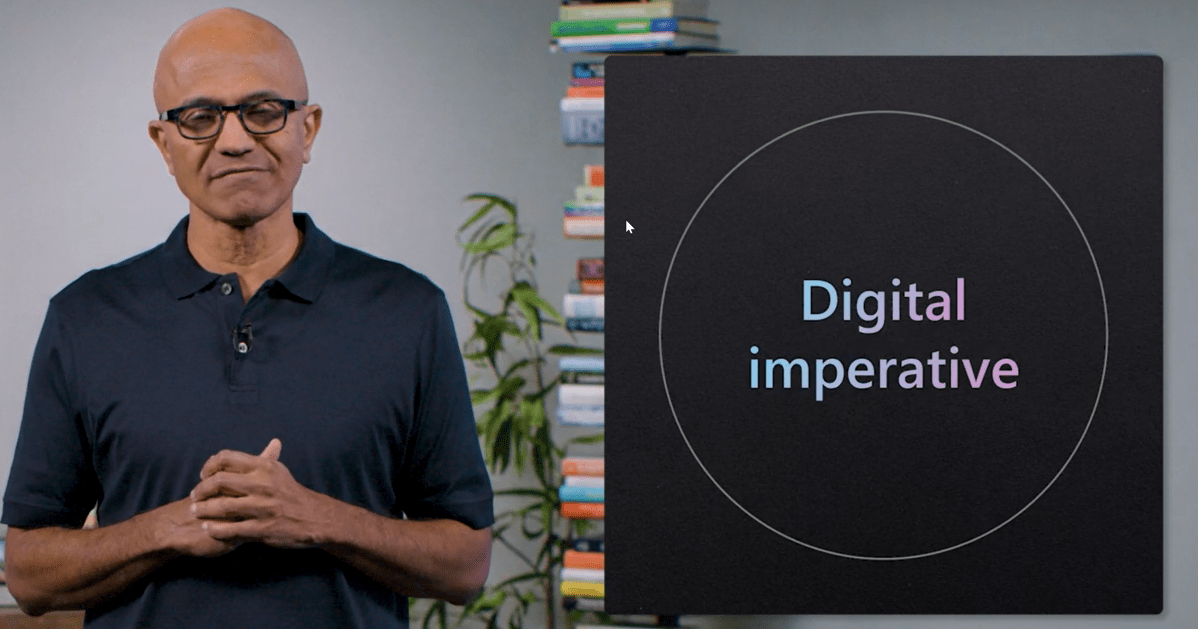
Judson Althoff EVP, Chief Commercial Officer officially started the Microsoft Ignite and the below is the capture of that moment. Microsoft Ignite kicked off today few hours ago and it is up and running live now and there were some great announcements came through so far from the sessions. I will be going to cover […]

Microsoft Ignite 2022 —
AIAnalyticsAzureDeveloperDevOps

Highlights from Microsoft Build 2021 | Digital Event

I’m happy to announce a Highlights from Microsoft Build 2021 digital event next Thursday, July 15. Please join me and other local experts as we look to provide key insights from the event that will help you expand your skillset, find technical solutions, and innovate for the challenges of tomorrow.

Here are the topics that will be covered:

  • .NET 6 and ASP.NET Core 6 and C#10
  • Internet of Things
  • DevOps
  • Kubernetes
  • Power Platform
  • Artificial Intelligence
  • Azure Functions
  • Entity Framework
  • Power BI

For more details about this event, please visit https://www.meetup.com/CTTDNUG/events/279130746/

Enjoy!

AIAzureEventsLearning

Microsoft Build 2021 Book of News

What is the Book of News? The Microsoft Build 2021 Book of News is your guide to the key news items that are announced at Build 2021.

As expected there is a lot of focus on Azure and AI, followed by Microsoft 365, Security, Windows, and Edge & Bing. This year the book of news is interactive instead of being a PDF.

Some of my favorite announcements

Azure Cloud Native and Application Platform

  • Running Azure app services being able to run on Kubernetes clusters anywhere with Azure Arc
  • Native support for WebSocket APIs in Azure API Management is now in preview
  • Azure Communication Services, the first fully managed communication platform offering from a major cloud provider, has new intelligent features and functionality to complete customers’ end-to-end communication experiences
  • Azure Logic Apps is now updated with new hosting options, improved performance and developer workflows
  • Durable Functions, an extension to Azure Functions that lets users write serverless workflows, now supports PowerShell

Azure Cosmos DB

  • With the introduction of the partial document update for Azure Cosmos DB, developers can modify specific fields or properties within a document without requiring a full document read and replace
  • Azure Cosmos DB serverless is now generally available for all APIs (Core, MongoDB, Cassandra, Gremlin and Table)
  • Azure Cosmos DB Linux emulator is now in preview
  • Azure Cosmos DB expanded free tier is now generally available
  • Azure Cosmos DB integrated cache is now in preview
  • Always Encrypted for Azure Cosmos DB is now in preview
  • Azure Cosmos DB role-based access control (RBAC) is now generally available

Click here to read the Microsoft Build 2021 Book of News!

Enjoy!

Resources

Build cloud-native applications that run anywhere.

Microsoft Build 2021: What’s new with Azure Communication Services?

Learn more about Azure Cosmos DB integrated cache and Azure Cosmos DB serverless.

AzureCloudDeveloperEventsIoT

Microsoft Ignite 2021 Book of News (March 2-4)

Microsoft Ignite starts today and runs until March 4. Once again this is a virtual event and registration will remain open during the duration of the event. You can register at https://register.ignite.microsoft.com/

As typical Microsoft provides a Book of News for the event. What is the Book of News? The Microsoft Ignite 2021 Book of News is your guide to the key news items that are announced at Ignite 2021.

Click here to read the Microsoft Ignite 2021 Book of News!

Further reading

If you missed out on Microsoft Ignite 2020 or want to quickly see what was announced, checkout the Microsoft Ignite 2020 Book of News for what was announced at that event.

Enjoy!

AzureCommunityEvents

Best of Build 2020 |Canada Community Edition | Virtual Event

Did you miss this year’s Microsoft Build 2020 virtual event? Do not worry at all!

Microsoft Canada and our community leaders are getting together to share some of the excitement with you – do join us on June 13th as we plan this Canada wide virtual event – delivered by some of the best we have, from East to the West of Canada!

I’ll be discussing Azure Static Web Apps – go from code to scale in minutes, plus other CI/CD announcements from Build.

Register TODAY !

Resources

https://lnkd.in/e9JCzFC

AzureEventsPersonal DevelopmentPostmortem

Postmortem for my Global Azure 2020 talk: Bringing serverless to the Enterprise

During my Global Azure Virtual 2020 live stream on Bringing serverless into the Enterprise, I had a few demo glitches. An inside joke for those that do presentations and demos is that the demo gods are either with you or against you. Some might say I didn’t offer up a satisfying sacrifice to the demo gods. I would argue and say I did but I feel it’s important to reflect and learn what went wrong and how I can be better prepared for the future by learning from our mistakes.

Prelude

So knowing that I presented on this topic for the Global Azure 2020 Virtual event and had some failed demos, I wanted to explain what happned and why and how to be better prepared for a future talk and hopefully it’s a lesson that you can learn from for your own talks, presentations or just development efforts.

Back in February 2020 I had submitted a few topics for the Global Azure 2020 event. At this point in time COVID-19 was going on but the world hadn’t shut down like it is today and the Global Azure 2020 event was still going to happen. In March I was notified that my topic was selected and I had about 6 weeks to prepare. Fast forward to mid March and everything was starting to be cancelled or made virtual. In the case of our local Global Azure 2020 event it was cancelled, so I didn’t work on my presentation. I was invited to participate in another Global Azure 2020 Virtual Community event in UK and Ireland so I focused on that content.

About 2 weeks prior to the Global Azure 2020 event, I was notified we would be making our local event virtual and I had to confirm if I still wanted to participate. At this point I was not prepared and my wife ended up signing up for a course over the weekend prior to the event – which left me with 3 kids (10 months, 4 yrs and 7 yrs) to manage for 10 hours each day over a 3 day weekend. My initial thought was to excuse myself from the event, but I really wanted to participate and with COVID-19 and everything halted, I found it was important to maintain that community connection even if it was a virtual event.

So this took me back to my college days of doing school, working and squeezing in a project over a tight deadline – not fun but with coffee as my partner, I got the kids to bed and started putting in a couple late nights to get it all done…or so I thought.

With my talk this year being on bringing serverless into the Enterprise, I focused on Azure Functions and my demos were on the following topics to illustrate common enterprise use cases:

  • Using PowerShell in a Azure Function for automation tasks
  • Deploy code to Azure using GitHub Actions
  • Avoiding cold start and latency with Premium Functions
  • Monitoring logs for your Functions

My PowerShell Azure Function Failure

My first failed demo was something I knew was being problematic going into the talk but I felt it was important to still talk about and I had screenshots of a working state from previous attempts so felt good to proceed. The demo was creating an Azure Function with PowerShell. The issue was that no matter what PowerShell command I tried to run, I kept getting errors that it could not be run successful as shown below and no matter what I did I kept getting an error that the subscription could not be set.
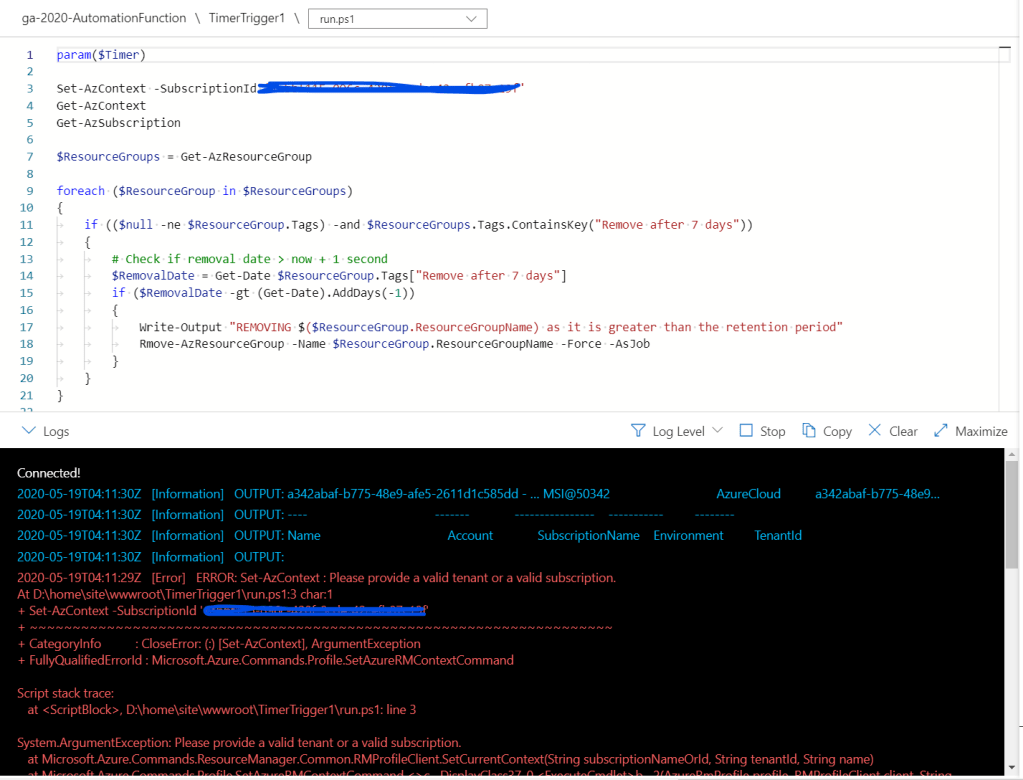
Because you never know if something will go off the edge during a demo, you should always be prepared to go ‘offline’. By that I mean show screenshots of what you were trying to do and the expected outcome. You could even go so far as recording your demo and then switching to that during your talk. I’ve never done this but I’ve heard some people have and it worked perfectly. The audience had no idea the demo was broken and they were able to convey their message.

That might be a bit extreme, but I usually do take some screenshots of the Azure portal as part of my notes I use to prepare the presentation, so I know I can always fall back to that if necessary and in this case that is what I did. It’s unfortunate I could not show the feature working as I intended, but I let the audience know and continue to roll along.

My Premium Function Failure

This was my favorite demo I prepared for the talk and it involved creating an Azure Function and hosting it on the Premium plan and then comparing that to the Consumption plan to show scale, latency and that there is no more cold start in Azure Functions with the Premium plan.

When I prepared this demo it was before I worked on the GitHub Actions demo – which would have come prior to this in my presentation. The order of the demos plays an important role in why this failed so I’ll come back to this later.

In order to show the cold start and latency issues with the Azure Functions Consumption plan and how the Premium plan avoids this I was using a load testing site called Loader.io. This tool required that the host URL be verified with a special token that had to be returned from the site. In order to map my Azure Function result to the expected URL that loader.io wanted I needed to configure and Azure Function Proxy.

I needed the following function URL http://ga2020-consumption-scale.azurewebsites.net/api/loaderio to return the verification token as if it was being called from this URL http://ga2020-consumption-scale.azurewebsites.net/loaderio-0cbce440ef982c13caba4130d3758183/.

When I was setting up the demo I first setup the proxy in the portal, and then I moved it so a proxies.json file in the Visual Studio solution as shown here
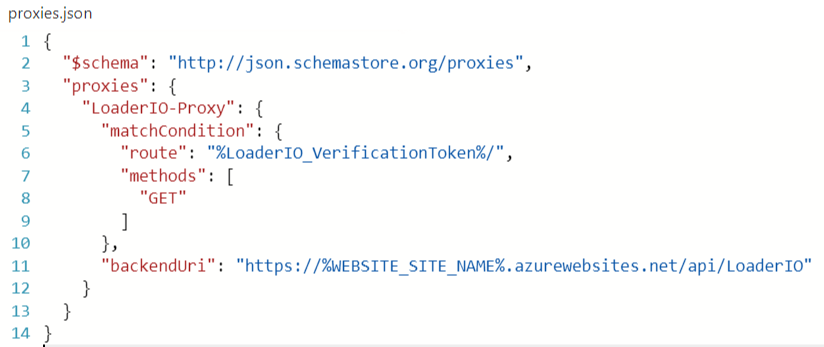
When I was testing this demo I was able to verify the token and use loader.io to load test my consumption and premium functions without issue. After getting this demo done I moved on to the GitHub Action demo and took a copy of the code and used that for the CI/CD to push it up into Azure and that demo worked without issue. When I tested the automated deployment, I just tested the function and not the load testing.

You may have an idea of what caused the failed demo, but if not it’s related to the proxies.json file. When I copied the file into my solution I forgot to go to the properties and mark it as content to be deployed. So in the GitHub Actions demo that took place prior to the load testing demo, it would have deployed a fresh copy and removed the Proxy I had originally setup in the portal. This meant that if I needed to validate the token from loader.io, I wouldn’t be able to and thus I saw the following error in my demo and was a bit surprised.
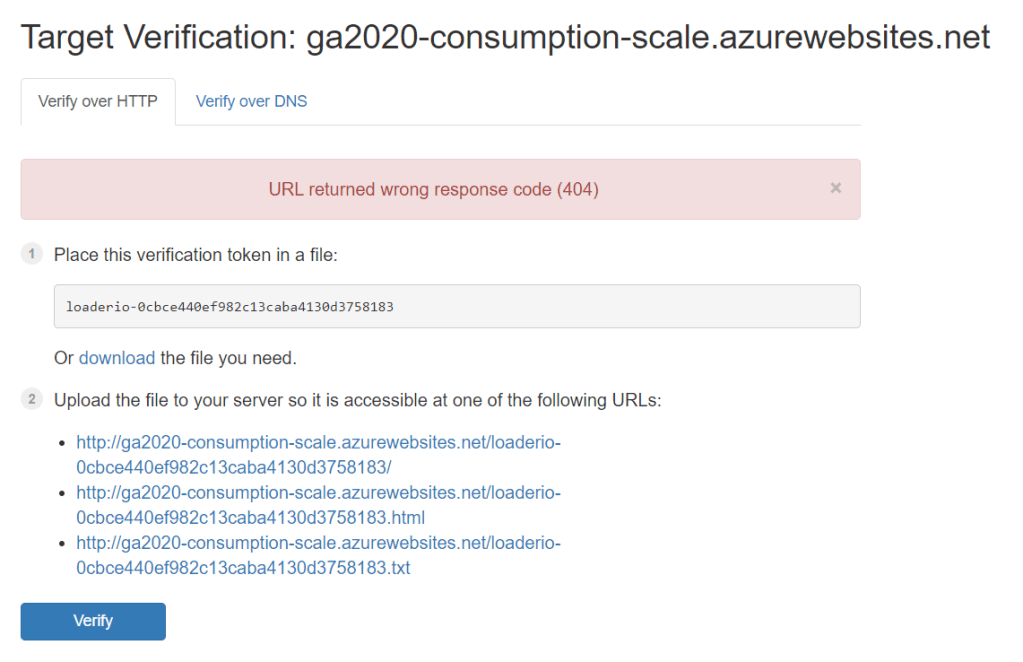
I didn’t have or want to take the time to live debug to find out what was wrong as I feared I would go down a rabbit hole and totally derail my talk. So I moved on and explained as best as I could what would have happened…again I have screenshots but it wasn’t as cool as showing it live.

Testing, rehearse and what went wrong

When I look back at that presentation, I had under 2 weeks to prepare and I was still working on the talk the morning of to finish up a few areas. I would not have left things to the last minute as I did but things were very fluid in Feb/Mar with COVID-19 and I wanted to put my best effort in for the community and felt I could still manage it but under not so ideal circumstances.

I worked on each demo individually as they weren’t really related except for the GitHub Action demo. I should have done that first because I would have caught the token verification issue right away due to the missing proxy.

Speaking of token verification, it would seem its valid for 24 hours and as I got close to the talk I didn’t want to warm up my functions as I wanted them in a cold state. So not testing them right before my talk I missed out on seeing that the token just expired, which would have shown me that the proxy was missing.

Due to the time crunch when I rehearsed I didn’t do my demos inline with the presentation, I did them separately. Again had I done the demos with the presentation I would have potentially caught the expired token and missing proxy. It’s important to do an end to end test and walk through of the presentation material regardless how comfortable you feel you are.

In retrospect I should have gone back and tried to troubleshoot this issue at the end of my talk. As soon as I looked at the function I noticed the proxy was missing and I was able to add it quickly which would have looked like this…
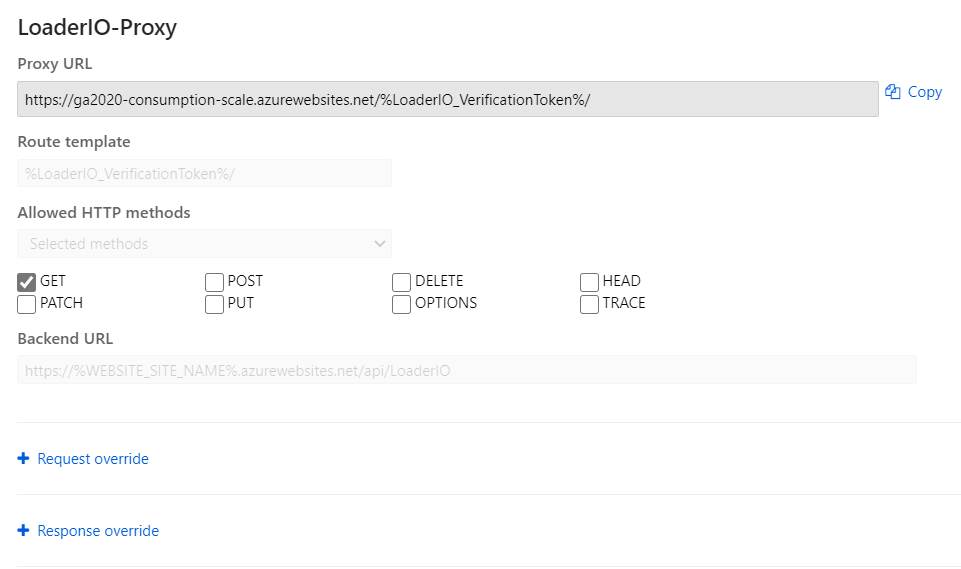
This would have only taken me 5 minutes to troubleshoot and fix which would have allowed me to show the real demo. All in all the talk went well and I got some really good feedback. No one complained about the broken demos and I mentioned that I would follow up with the blog post to show what was wrong and how I fixed it. I was a bit disappointed that I couldn’t show this demo live as its pretty awesome to see, so look for a future blog post where I’ll setup a Premium function and throw some load at it – maybe I’ll even record it and post to YouTube.

I hope you enjoyed this post and found something useful. I find it’s important to acknowledge when we do run into issues and how we solve them.

Enjoy!

References

Global Azure Virtual 2020 live stream on Bringing serverless into the Enterprise