Happy New Year everyone! To kick off the new year I’d like to share with you what happened in 2020, what it meant to me, and where I plan on going in 2021.
Events
Microsoft Ignite Tour – Toronto
I spoke with my good friend Ehsan on Windows IoT and Azure.
My family tagged along with me and we got a hotel downtown Toronto. The kids always love doing this and they were nice and close had I needed to go see help.
Got to see lots of friends at the event, in the speaker room, and at an Microsoft MVP social dinner.
Was planning on attending my second Microsoft MVP Summit in Redmond, Seattle…then the lockdown and cancellation happened with respect to COVID-19. The summit was cancelled from an in person event to an online virtual summit. I was sad to not travel out to Redmond and be on the Microsoft campus but was thrilled that they moved it online and I absorbed every minute of it. It’s truly incredible to be part of an amazing community of people that have a passion for this stuff and you get to interact with the various product teams from Microsoft and hear about what’s coming.
Presented at two Global Azure events, one in Toronto, Canada and the other was in the UK.
Because of COVID-19, all social gatherings and community events stopped and moved online. I was thankful to keep busy and continue to present at various meetups around the GTA.
Speaking of meetups I took on the organizer and user group leader role for CTTDNUG in Kitchener, Ontario.
Other
Like most of you, I’ve been working from home since March. I like it as I get to spend more time with my family and with 3 young kids, I get to see more of them during the day and have those special moments that I would have otherwise missed had I been in the office. On the other hand, I do miss the social setting and engaging with my co-workers in person. It seems like now I spend half my day on Teams calls.
What didn’t happen
2020 was an interesting year that really went sideways and threw off the plans I had. I didn’t get around to working on my certifications, but funny enough I managed to start two colleagues on their own Azure certification path.
I missed out on a lot of blogging in the second half of the year that I had planned to do. I was and still am working on a large Azure migration for a client. I’m helping them move to Azure API Management, building new applications with Azure Functions, Cosmos DB, Storage, Event Grid and so many other Azure services. Plus there is the on-prem to Azure migration for the data center and consolidating their CI/CD processes into Azure DevOps. I had started on a number of these posts but the reality is working from home is different and it truly requires a good plan for work/life balance. I think I spent most of the second half of the year figuring that out.
What’s to come in 2021
I see 2021 as a year of exciting opportunities and challenges. I will be looking to finally tale some Azure certifications and continue to expand my knowledge deeper into Azure. I will continue to speak at user groups and conferences. I already have a few speaking engagements lined up for January, February and March. My first conference to submit a talk on will be for the Global Azure Bootcamp (Mississauga) in April.
There will be no in-person Microsoft MVP Summit this year but it will be online and virtual again, so I’m excited for that event to connect with the MVP community and to learn what I can from the Azure product teams.
I doubt there will be a Microsoft Build or Ignite conference this year in person, but that would be a conference I would look forward to attending in 2022 if possible. Only time will tell.
Happy New Year, and may you all have a fantastic year!
In this episode of Azure Friday, Jimmy Campbell is back to show Scott Hanselman how to use App Configuration for feature management. Traditionally, shipping a new application feature requires a complete redeployment of the application itself, and testing a feature often requires multiple deployments of the application. Now you can use feature flags in App Configuration to grant early access to new app functionality in production.
In this episode of Azure Friday, Jeremy Likness shows Scott Hanselman how to use Entity Framework (EF) Core with Azure SQL DB and Azure Cosmos DB. EF Core is a lightweight, extensible, open source, and cross-platform version of the popular Entity Framework data access technology.
[0:00:00]– Overview [0:01:43]– Using Entity Framework Core with Azure SQL DB (existing) [0:10:23]– Sidebar: Resolving a demo hiccup [0:15:07]– Using Entity Framework Core with Azure Cosmos DB (new) [0:22:09]– Wrap-up
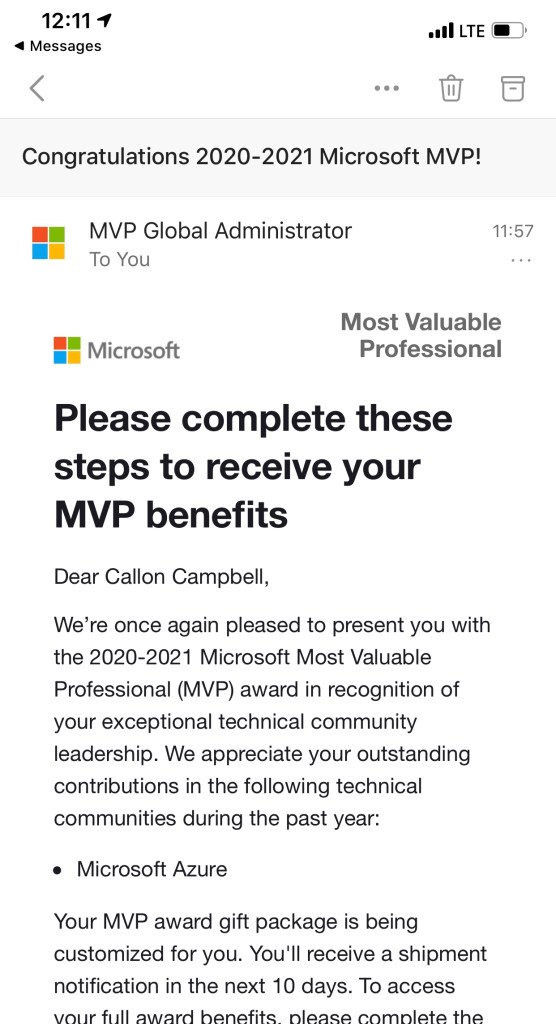
This week I received an exciting email from Microsoft that I was re-awarded for a third year now for the 2020 – 2021 Microsoft Most Valuable (MVP) award in Azure. Receiving the Microsoft MVP award is both a humbling and an exciting experience. It means you’re a member of a select group of experts of just over 2,000 MVPs from around the world, but I like to think of it as doing something I’m passionate about with other like minded individuals, having fun and always having something new to learn and share with the community.
The Microsoft MVP Award is an annual award that recognizes exceptional technology community leaders worldwide who actively share their high quality, real world expertise with users and Microsoft. All of us at Microsoft recognize and appreciate Callon’s extraordinary contributions and want to take this opportunity to share our appreciation with you.
The Microsoft Most Valuable Professional (MVP) Award Team Microsoft Corporation
Since becoming a Microsoft MVP, I’ve learned a lot about the community and continued to share my passion, knowledge and experience within the community around Architecture and Development in Azure, DevOps and Serverless technologies. I also keep a keen eye on what’s happening on the data technologies like Cosmos DB and Azure SQL.
I was really looking forward to attending the MVP Summit back in March, but COVID-19 threw a wrench in that plan. Thankfully Microsoft moved the event online and it was still an amazing experience to connect with the product teams and MVPs from around the world – even if it was virtually.
If you’re interested in learning about the Microsoft MVP program and seeing what it takes to become a Microsoft MVP, or how to get awarded, I encourage you to take a look at the Microsoft MVP website and also the following article on “How to become a Microsoft MVP” where they explain some of the details of the program.
To wrap up this post I would like to congratulate all the other newly awarded, or renewed Microsoft MVP’s all over the world! You truly are an amazing community and I’m truly humbled and honored to be part of this group.
Did you miss this year’s Microsoft Build 2020 virtual event? Do not worry at all!
Microsoft Canada and our community leaders are getting together to share some of the excitement with you – do join us on June 13th as we plan this Canada wide virtual event – delivered by some of the best we have, from East to the West of Canada!
I’ll be discussing Azure Static Web Apps – go from code to scale in minutes, plus other CI/CD announcements from Build.
Originally posted on The Frog Pond of Technology: A peer of mine recently asked about how I manage local code (projects, solutions, Git repos, etc.) that may or may not be synced to a cloud repository (GitHub, Azure DevOps, etc.) Since I previously blogged about How I Blog – Updated 2018 and I’m a fan…